Hibiscus Studio
A1K1_African Violet Botanical Water Bottle | Kenya Native
A1K1_African Violet Botanical Water Bottle | Kenya Native
Couldn't load pickup availability
Flower Details
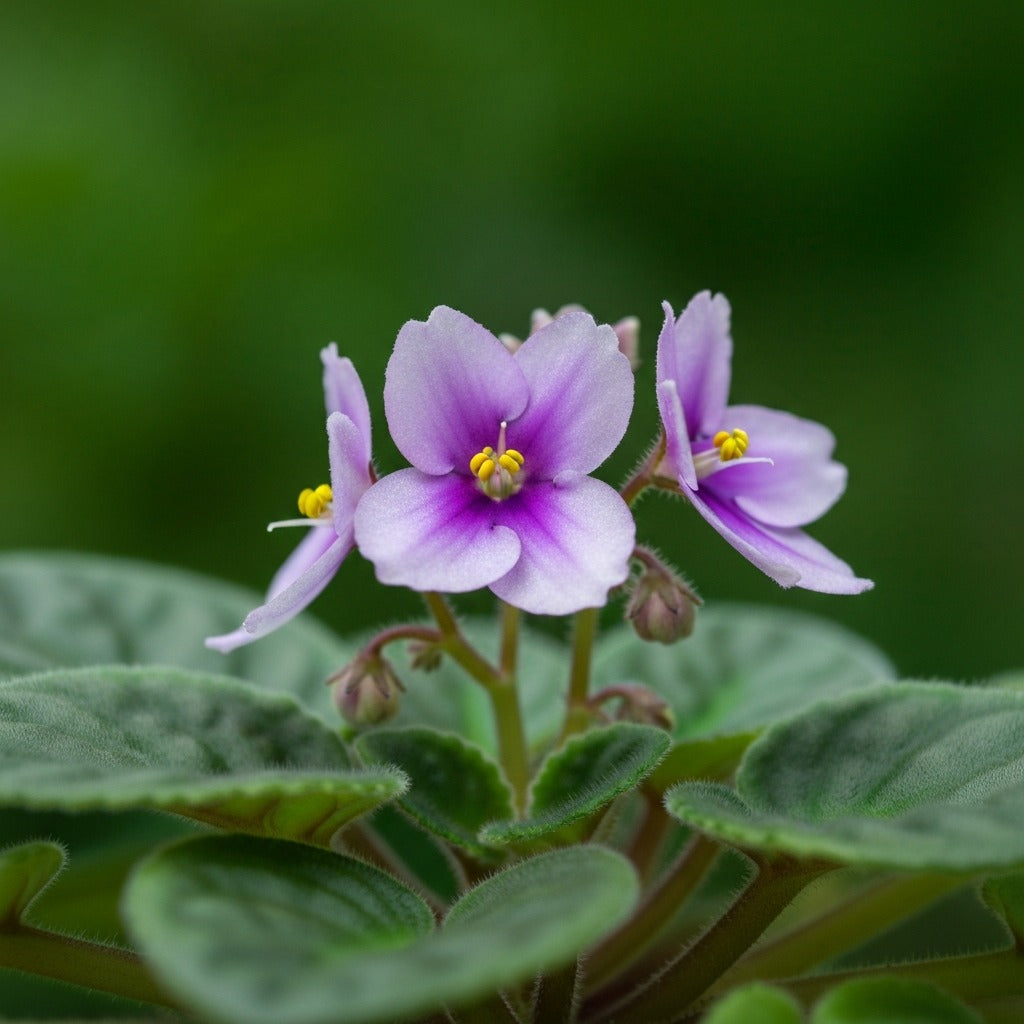
- Common name: African Violet
- Country of origin: Kenya
- Region: Africa
Bottle Specifications
- High-grade stainless steel
- 17 oz (500 ml)
- Dimensions: 10.5″ × 2.85″ (27 × 7 cm)
- Vacuum flask
- Double-wall construction
- Bowling pin shape
- Glossy finish
- Odorless and leak-proof cap
- Keeps liquids hot or cold for 6 hours
- Hand-wash only
About the African Violet
Common name: African Violet
Scientific name: Saintpaulia ionantha (family Gesneriaceae)
Native country: Kenya (and neighbouring Tanzania); indigenous to the Eastern Arc Mountains of East Africa
Plant height: Typically grows 6–15 cm (2.5–6 inches) tall, depending on cultivar and growing conditions
Flower colour: Typically violet-purple; cultivated varieties range from deep purple and blue to pale lilac, pink, and white
Flowering season: Capable of flowering year-round under consistent indoor conditions; in its native highland habitat, flowering is tied to the cool, moist seasons of the Usambara and Taita Hills
What It's Known For
- Native to the mist-laden highland forests of coastal East Africa, growing on shaded, mossy rock faces and stream banks in Kenya and Tanzania
- Belongs to the family Gesneriaceae, a large family of flowering plants adapted to humid, low-light environments [POWO]
- Became one of the most widely cultivated houseplants in the world after its introduction to European horticulture in the late 19th century [Common botanical/general knowledge]
- First collected by German colonial officer Baron Walter von Saint Paul-Illaire in 1892 in German East Africa (present-day Tanzania), after whom the genus Saintpaulia was named [Common botanical/general knowledge]
- Known for its ability to flower almost continuously indoors, making it exceptional among flowering houseplants [Common botanical/general knowledge]
- Hundreds of cultivated varieties (cultivars) have been developed by breeders, spanning a wide range of flower colours, petal forms, and leaf textures [Common botanical/general knowledge]
- The African Violet Society of America, founded in 1946, is one of the most prominent single-plant horticultural societies in the world, reflecting the depth of collector culture around this flower [Common botanical/general knowledge]
- In its native East African habitat, the plant grows in highly specific microenvironments — cool highland forest, rocky outcrops, and stream margins — making it ecologically sensitive and increasingly threatened by habitat loss [Common botanical/general knowledge]
- The flower's common name reflects both its geographic origin and the violet-like colour of its most familiar form, though it is not botanically related to true violets (Viola spp.) [Common botanical/general knowledge]
The Story
The Taita Hills rise out of southeastern Kenya like a rumour of cooler air. At their edges, where the forest thickens and the light turns green and diffuse, moisture clings to every surface — to moss, to bark, to the shaded faces of rock. It is here, in the shadow of one of East Africa's most biodiverse highland pockets, that a small, unassuming plant pushes its purple flowers toward whatever light filters through. You could walk past it. Most people would. But once seen, it stays with you.
In 1892, Baron Walter von Saint Paul-Illaire — a German colonial officer stationed in what is now Tanzania — collected specimens from the highland forests of German East Africa and forwarded seeds to the Royal Botanical Gardens in Herrenhausen, Germany, where the plant flowered in cultivation and caused an immediate sensation. Botanists named the genus Saintpaulia in his honour, and within a generation the plant had moved from greenhouse curiosity to windowsill companion across Europe and North America. What had evolved over millennia to bloom in the cool mist of East African hillsides found itself, improbably, thriving on kitchen sills in Paris, London, and Detroit — a testament to how precisely it had adapted to low light and gentle, consistent care. By the mid-twentieth century, dedicated grower societies had formed on multiple continents, trading cultivars and comparing blooms with the intensity of serious collectors. The plant had, quietly, become a phenomenon.
What made the African Violet so enduring was not spectacle but intimacy. It does not demand a garden or a season. It asks only for indirect light, a little water, and some patience — and in return it flowers almost without pause. In this way it became something unusual in the world of horticulture: a flower of the indoors, a bloom that belonged not to the garden but to the room, to the desk, to the space where a person actually lives. Its presence in a home was never accidental. You had to choose it, tend it, notice it. It rewarded attention.
That quality connects back to where it came from. The forests of Kenya's highland regions are not wilderness in the dramatic, open-sky sense. They are intimate landscapes — layered, dense, full of things you only see if you slow down. The African Violet grew in that school. It learned, over millions of years of evolution, to make the most of constrained conditions: thin light, narrow ledges, seasonal mist. The flower that emerged from those pressures is small in scale but vivid in colour, delicate in form but surprisingly persistent. It is, in the truest botanical sense, a flower built for endurance in quiet places.
There is something worth carrying in that. The idea that beauty does not require grand conditions — that it can be found in constrained, overlooked corners and still be wholly itself. This bottle was made for the person who understands that instinctively: who finds meaning in small, vivid things, who tends what they love with consistency rather than drama. It is why Hibiscus chose this particular story to travel with you — a flower from the mist-forests of Kenya, now held in the palm of your hand.
What It Stands For
The African Violet stands for quiet endurance — the particular resilience of beauty that does not need grand conditions to persist, only constancy and care.
The Perfect Gift
For the person in your life who loves the natural world — who has a soft spot for flowers, feels most at home outdoors, or simply appreciates a beautiful thing that means something real.
Give it for a birthday, a milestone, or any day that deserves a gift she'll actually use. Whether it goes on the trail, to the desk, or on the kitchen bench — it'll be reached for every single day. And every time she does, she carries a story from somewhere real, something that has lasted.
Not just a bottle. The whole story. She just gets to drink from it.
Share