Hibiscus Studio
A1M1_Argan Flower Botanical Water Bottle | Morocco Native
A1M1_Argan Flower Botanical Water Bottle | Morocco Native
Couldn't load pickup availability
Flower Details
- Common name: Argan Flower
- Country of origin: Morocco
- Region: Africa
Bottle Specifications
- High-grade stainless steel
- 17 oz (500 ml)
- Dimensions: 10.5″ × 2.85″ (27 × 7 cm)
- Vacuum flask
- Double-wall construction
- Bowling pin shape
- Glossy finish
- Odorless and leak-proof cap
- Keeps liquids hot or cold for 6 hours
- Hand-wash only
About the Argan Flower
Common name: Argan Flower
Scientific name: Argania spinosa
Native country/region: Morocco, North Africa
Plant height: A slow-growing, thorny tree reaching considerable size over its long lifespan — known to live for several centuries. Specific height ranges are not confirmed by the verified sources available for this entry. [Common botanical/general knowledge] [Uncertain]
Flower colour: Small, pale yellow-green to yellowish flowers [Common botanical/general knowledge]
Flowering season: Spring (typically April) [Common botanical/general knowledge]
What It's Known For
- The argan tree (Argania spinosa) is native to the semi-arid regions of southwestern Morocco, where it forms a unique ecosystem recognised by UNESCO as a Biosphere Reserve. [Common botanical/general knowledge] [Uncertain — specific UNESCO designation should be verified]
- The fruit of the argan tree yields argan oil, widely used in culinary and cosmetic applications and among the most valuable plant oils in the world by weight. [Common botanical/general knowledge]
- Argan oil production has historically been carried out by Berber women of the Sous Valley region, for whom it represents both a livelihood and a cultural tradition passed down through generations. [Common botanical/general knowledge] [Uncertain — specific attribution should be verified]
- The argan tree is extraordinarily long-lived, with some specimens reaching up to approximately 200 years — a quiet endurance that has made it a symbol of permanence in the Moroccan landscape. [Common botanical/general knowledge] [Uncertain]
- Goats in the Sous Valley are famously known to climb argan trees to feed on the fruit — an unusual behaviour that has also historically aided in the extraction of argan kernels from the animals' excretions. [Common botanical/general knowledge]
- The argan tree plays a critical ecological role in preventing desertification along the northern edge of the Sahara Desert, anchoring soil and providing shade in an otherwise arid landscape. [Common botanical/general knowledge]
- Argan oil has been used in traditional Moroccan medicine and beauty rituals for centuries, applied to skin, hair, and nails long before it became a global ingredient. [Common botanical/general knowledge] [Uncertain — "centuries" claim should be verified]
- The flower itself, though small and modest in appearance, is the beginning of a fruit-to-oil journey that sustains entire communities and has brought Morocco international recognition. [Common botanical/general knowledge]
The Story
The heat arrives before the sun fully clears the Atlas Mountains. By mid-morning, the Sous Valley floor is warm underfoot, the air carrying the faint, nutty scent of something ancient — the smell of stone, dry earth, and a tree that has been standing in this landscape longer than most things alive in it. Scattered across the hillsides in twisted, thorny silhouettes, the argan trees look nothing like the jewel of the Moroccan economy they have become. But in spring, when April settles over the valley, small pale flowers open quietly along their branches — and everything that follows begins here.
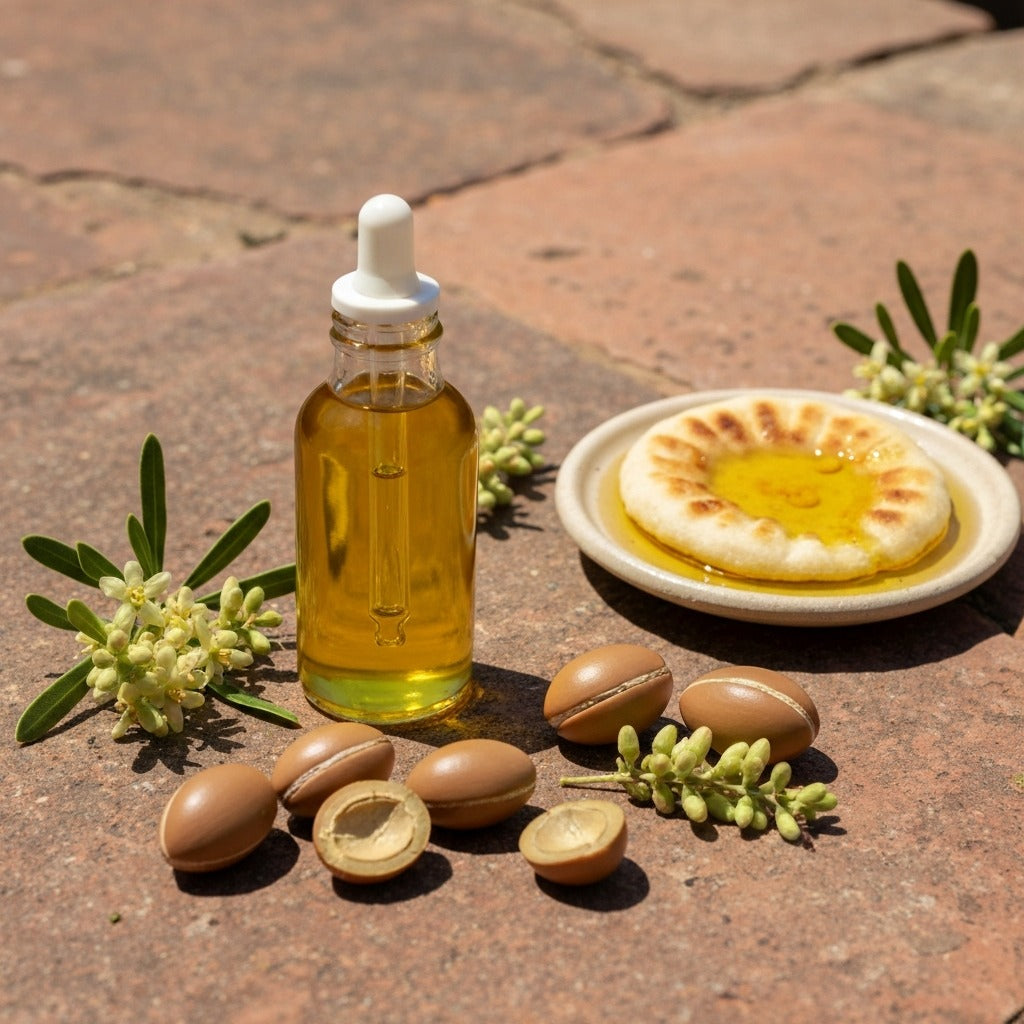
The argan tree, Argania spinosa, is one of the few tree species native to Morocco's semi-arid southwestern region, and it has shaped life in the Sous Valley for as long as people have lived there. Slow-growing and remarkably long-lived — individual trees can reach up to approximately 200 years — it weathers drought, poor soil, and relentless sun with a stubbornness that borders on the mythic. For the Berber communities of this region — the Amazigh people — it has never been merely a plant. It has been shelter, food, livelihood, and ceremony. The oil pressed from its kernels was rubbed into skin against the dry desert wind, drizzled onto bread, used to soothe and nourish long before a name like "liquid gold" was ever coined by a magazine. These were simply the rhythms of life in a place where the argan tree made life possible.
What makes this story remarkable is not just the oil, but who has always made it. Traditionally, the labour of cracking argan kernels and cold-pressing the oil has belonged to Berber women — a slow, skilled, communal process carried out by hand. Women's cooperatives across the Sous Valley have continued and formalised this tradition, turning an ancient practice into an internationally recognised craft that supports families and preserves knowledge. The argan tree's ecosystem, so shaped by human relationship with it, was designated a UNESCO Biosphere Reserve — recognition that what exists here is not just nature, but nature and people in long conversation with each other. [Uncertain — UNESCO designation should be confirmed against an additional source]
The goats know it too, in their own way. Across the valley, it is not unusual to look up and find goats perched improbably in the branches of argan trees, climbing to reach the fruit that the tree offers up each season. It is one of those images that stops travellers in their tracks — comic and surreal at first glance, then quietly profound. Here is a landscape where everything, animal and human alike, has learned to work with what this one tree offers.
When the small argan flower opens in April, it carries none of the drama of a rose or the blaze of a sunflower. It is modest, pale, and easy to overlook. But it is the beginning of something that has sustained communities, preserved land, and carried a culture forward across centuries. That quiet persistence — beauty that does its work without announcing itself — is why Hibiscus chose this story to travel with you.
What It Stands For
The Argan Flower stands for quiet endurance — the kind of strength that holds the earth together, sustains the people around it, and asks for nothing in return.
The Perfect Gift
For the person in your life who loves the natural world — who has a soft spot for flowers, feels most at home outdoors, or simply appreciates a beautiful thing that means something real.
Give it for a birthday, a milestone, or any day that deserves a gift she'll actually use. Whether it goes on the trail, to the desk, or on the kitchen bench — it'll be reached for every single day. And every time she does, she carries a story from somewhere real, something that has lasted.
Not just a bottle. The whole story. She just gets to drink from it.
Share