Hibiscus Studio
A1M1_Orange Blossom Botanical Water Bottle | Morocco Native
A1M1_Orange Blossom Botanical Water Bottle | Morocco Native
Couldn't load pickup availability
Flower Details
- Common name: Orange Blossom
- Country of origin: Morocco
- Region: Africa
Bottle Specifications
- High-grade stainless steel
- 17 oz (500 ml)
- Dimensions: 10.5″ × 2.85″ (27 × 7 cm)
- Vacuum flask
- Double-wall construction
- Bowling pin shape
- Glossy finish
- Odorless and leak-proof cap
- Keeps liquids hot or cold for 6 hours
- Hand-wash only
About the Orange Blossom
Common name: Orange Blossom
Scientific name: Choisya ternata
Native country/region: Mexico (native range per POWO); Morocco is not a recognized native country for Choisya ternata
Plant height: [Uncertain — no height figure provided in POWO or Wikipedia sources; qualitative phrasing used] A small to medium shrub, typically compact and bushy in form.
Flower colour: White
Flowering season: Spring, with some varieties flowering again in late summer or early autumn [Common botanical/general knowledge]
What It's Known For
The Wikipedia extract retrieved for "Orange Blossom" returned results for a French music band, not the botanical flower. The POWO entry confirms the accepted scientific name Choisya ternata, and Wikidata describes it as "the fragrant flower of the orange tree." The botanical and cultural facts below draw on common botanical/general knowledge and are tagged accordingly. Hong or Marketing AI should review before approving.
- Celebrated for its intensely sweet, citrus-floral fragrance — among the most distinctive scents associated with any flowering tree [Common botanical/general knowledge]
- The flowers are the source of two distinct aromatic extracts used in perfumery: neroli (steam-distilled from the blossoms) and orange flower absolute (solvent-extracted) [Common botanical/general knowledge]
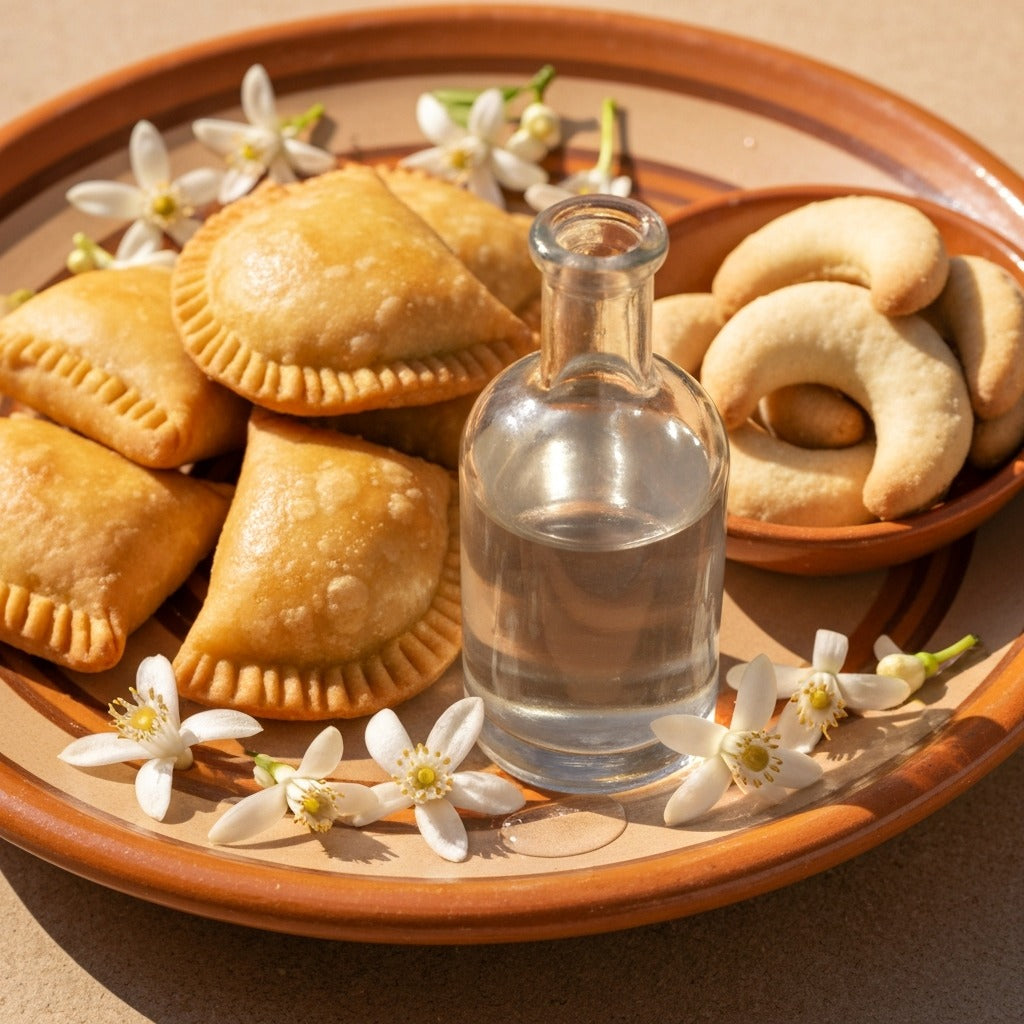
- Orange blossom water (a by-product of neroli distillation) is a staple ingredient in North African and Middle Eastern cooking, used in pastries, sweets, and beverages [Common botanical/general knowledge]
- In Morocco, orange blossom water and neroli production are centred around the Meknès and Fez region, where groves of bitter orange (Citrus aurantium) are cultivated specifically for their flowers [Uncertain]
- A traditional symbol of purity and good fortune; worn by brides as garlands or woven into bridal crowns across Mediterranean and North African cultures for centuries [Common botanical/general knowledge]
- Orange blossom honey — produced by bees that forage predominantly on orange tree flowers — is among the most prized varietal honeys across North Africa and the Mediterranean [Common botanical/general knowledge]
- The blossom is closely associated with the city of Seville in Spain and with Morocco's citrus-growing regions around Fez and Marrakech, where flowering season draws visitors for the scent alone [Uncertain]
- Used in traditional Moroccan herbal medicine as a mild calming agent; orange blossom water is commonly served as a digestive tisane or added to warm milk [Common botanical/general knowledge]
The Story
The air changes before you see a single flower. Walk through the medina in spring — through the narrow passages of Marrakech or the shadowed lanes of Fès — and you will smell it first: a white, weightless sweetness that seems to arrive from nowhere and everywhere at once. It softens the dust, cuts through the spice, and for a moment makes the whole city feel stilled. That scent is the orange blossom, and in Morocco, it marks one of the year's most quietly sacred weeks.
The bitter orange tree — Citrus aurantium — arrived in North Africa centuries ago, introduced by Arab traders during the Arab Agricultural Revolution, between the 7th and 10th centuries AD. Unlike the sweet orange grown for eating, the bitter orange is cultivated almost entirely for what it gives off: its rind, its peel, and above all its flowers. Each spring, in the groves around Meknès and Fez and in Morocco's citrus-growing heartland further south, the blossoms are harvested by hand — gathered at dawn, when the volatile oils that carry the fragrance are at their most concentrated. What follows is a careful distillation process that has remained largely unchanged for generations. From the steam that passes through those small white flowers comes neroli — an essential oil so valued in classical perfumery that it has been used in some of the world's most enduring fragrances — and orange blossom water, a gentler by-product that finds its way into almost every Moroccan kitchen.
That kitchen presence is part of what makes the orange blossom unlike most celebrated flowers. It does not only sit in a vase or a poem. It is tasted. A few drops of orange blossom water stirred into a bowl of chebakia during Ramadan, splashed over a platter of kaab el ghazal at weddings and festive celebrations, poured into warm milk at the end of a long day — its role in daily Moroccan life is functional, sensory, and deeply habitual. It is also ceremonial. Across North Africa and the broader Mediterranean, orange blossom has been braided into bridal crowns and woven into wedding garlands for generations, worn as a symbol of purity and the promise of a new beginning. The bride carries the scent with her into the ceremony the way she carries her family's wishes: quietly, close to the skin.
There is something particular about a flower whose value is almost entirely invisible — carried in scent, in flavour, in a few drops of water. It cannot be pressed into a photograph and shown off. It has to be experienced. That is what makes the orange blossom so enduring in the cultures that know it best: it asks you to slow down and pay attention, to notice the air before you notice anything else. It rewards presence over observation.
That quality — the invitation to be fully somewhere — is exactly what this bottle is for. It is a daily object with a real story behind it, drawn from a place where beauty has always been something you encounter rather than something you display. That is why Hibiscus chose this story to travel with you: because the orange blossom does not announce itself, it simply arrives — and you are always glad when it does.
What It Stands For
The Orange Blossom stands for sensory presence, the quiet ceremony of everyday life, and the enduring promise carried in a single, fleeting scent.
The Perfect Gift
For the person in your life who loves the natural world — who has a soft spot for flowers, feels most at home outdoors, or simply appreciates a beautiful thing that means something real.
Give it for a birthday, a milestone, or any day that deserves a gift she'll actually use. Whether it goes on the trail, to the desk, or on the kitchen bench — it'll be reached for every single day. And every time she does, she carries a story from somewhere real, something that has lasted.
Not just a bottle. The whole story. She just gets to drink from it.
Share