Hibiscus Studio
A1S1_Kniphofia Botanical Water Bottle | South_Africa Native
A1S1_Kniphofia Botanical Water Bottle | South_Africa Native
Couldn't load pickup availability
Flower Details
- Common name: Kniphofia
- Country of origin: South Africa
- Region: Africa
Bottle Specifications
- High-grade stainless steel
- 17 oz (500 ml)
- Dimensions: 10.5″ × 2.85″ (27 × 7 cm)
- Vacuum flask
- Double-wall construction
- Bowling pin shape
- Glossy finish
- Odorless and leak-proof cap
- Keeps liquids hot or cold for 6 hours
- Hand-wash only
About the Kniphofia
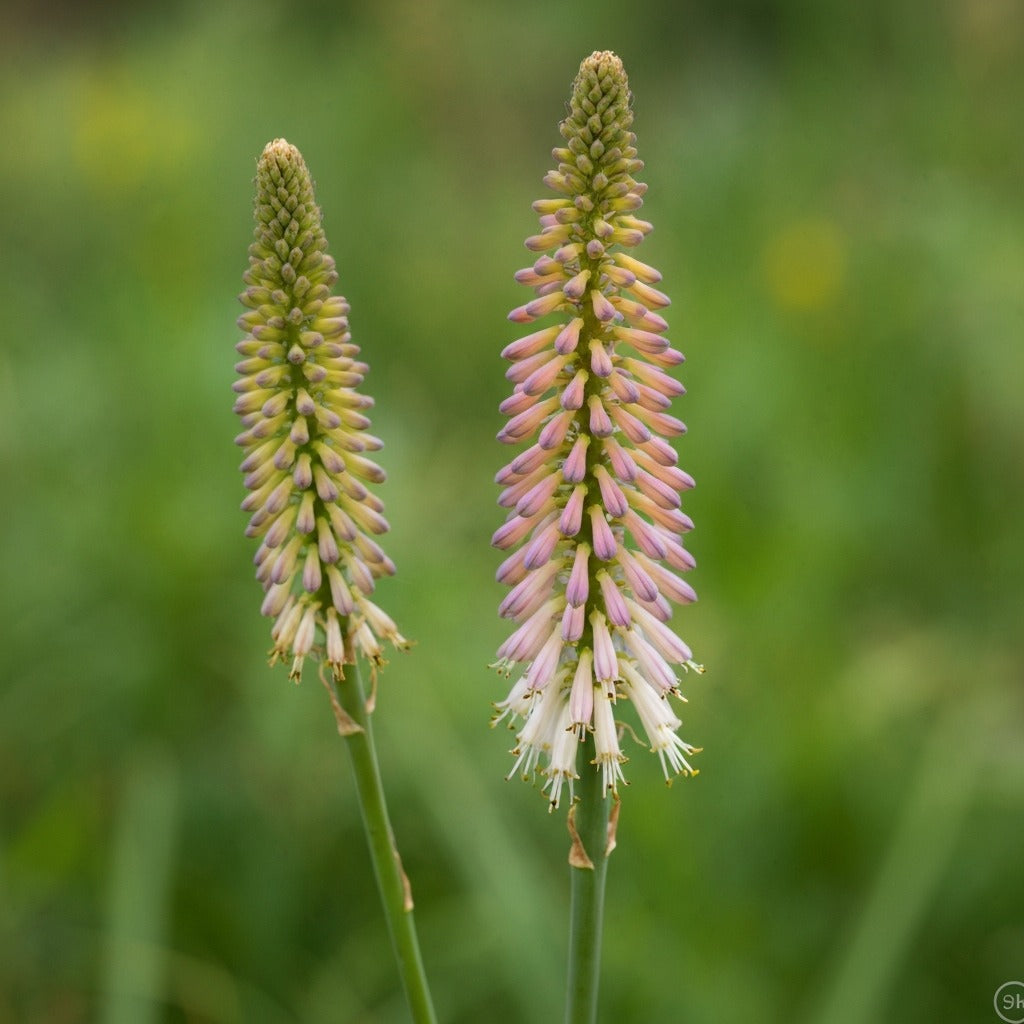
Common name: Red Hot Poker / Torch Lily / Tritoma / Poker Plant
Scientific name: Kniphofia (genus, family Asphodelaceae)
Native region: All species native to Africa; centred primarily across southern and eastern Africa, with South Africa — particularly KwaZulu-Natal and the Cape Provinces — representing the richest concentration of species
Plant height: No precise height figure is confirmed by POWO for the genus as a whole. Across the genus, herbaceous species and hybrids produce narrow, grass-like leaves between 10–100 cm (4 in–3 ft 3 in) long, while evergreen species carry broader, strap-shaped foliage reaching up to 1.5 m (5 ft) — making Kniphofia anything from a compact ground-level clump to a bold, upright statement plant depending on species.
Flower colour: Shades of red, orange, and yellow — frequently bicoloured, with the upper florets typically deeper in tone than the lower ones, creating the characteristic flame gradient the plant is named for
Flowering season: Varies by species and region; typically spring through summer in southern Africa [Common botanical/general knowledge]
What It's Known For
- The genus Kniphofia was first formally described and named in 1794 by German botanist Conrad Moench, who recognised it as distinct from the genus Aletris established by Carl Linnaeus. The name honours Johann Hieronymus Kniphof, an 18th-century German physician and botanist.
- All 73 currently accepted species (as of February 2025, per Plants of the World Online) are native to Africa — making it a wholly African genus with no wild natural populations on any other continent.
- The flower spikes produce copious nectar while in bloom, making them a significant food source for bees and nectar-feeding birds including sugarbirds and sunbirds.
- In the New World, where Kniphofia is widely cultivated as an ornamental, the flowers attract nectarivores such as hummingbirds and New World orioles.
- The Ethiopian wolf (Canis simensis) has been documented feeding on the nectar of Kniphofia foliosa — thought to make it the only large carnivore known to potentially act as a pollinator of any plant species.
- The genus encompasses both herbaceous and evergreen species, spanning an extraordinary range of scale: from compact, grass-leaved plants to tall, strap-leaved architectural specimens.
- Species are distributed widely across Africa, from South Africa and Lesotho through East Africa (Tanzania, Kenya, Uganda, Ethiopia) to central Africa (Congo/Zaire) and as far as Madagascar, Eritrea, and Sudan.
- The vivid, torch-shaped flower spikes rising dramatically above the foliage have made Kniphofia one of the most recognisable African ornamental genera in international horticulture and garden design.
- The common names — Red Hot Poker, Torch Lily — both derive directly from the flower's visual character: a column of intensely coloured, densely packed tubular florets that genuinely resembles a burning torch or a glowing iron poker.
The Story
The highveld is in full summer heat. The grasslands of KwaZulu-Natal stretch open in every direction, gold and green and wide, and somewhere in among the tall grasses — exactly where you'd least expect a flame — something is burning. Not fire, but close enough to stop you. A spike of red-to-gold, rising clean and vertical from a clump of narrow leaves, blazing against the blue sky of a South African afternoon. You don't forget it.
The plant that produces this flame has been part of the African landscape for far longer than European science knew what to call it. When Conrad Moench, a German botanist, formally named the genus in 1794, he did so because the plant was simply too distinct to fit anywhere already mapped. He named it for his colleague Johann Hieronymus Kniphof, an 18th-century German physician and botanist who had devoted years to the documentation of the plant world — a fitting tribute, since Kniphofia demands documentation. It insists on being noticed. Across southern and eastern Africa, from the Cape Provinces to Ethiopia, from Madagascar to the highlands of Sudan, 73 accepted species grow wild — every single one of them native to this continent, to no other.
What makes Kniphofia remarkable is not just what it looks like, but what it sustains. While in bloom, the torchlike spikes produce copious nectar, feeding bees, sugarbirds, and sunbirds that arrive in numbers. In Ethiopia, researchers have documented something stranger still: the Ethiopian wolf — Canis simensis, one of Africa's rarest large carnivores — visits Kniphofia foliosa to drink from its flowers. The wolf pushes its narrow muzzle into each floret and, in doing so, carries pollen from plant to plant. It is thought to be the only large carnivore anywhere on earth known to act as a pollinator. A predator, cross-pollinating a flower. Africa contains multitudes.
Beyond the continent, Kniphofia travelled. Cultivated widely as an ornamental across temperate gardens, it became a staple of the herbaceous border — where in the New World it draws hummingbirds and orioles that have never known the African grasslands that made it. The plant adapted. It brought its drama with it. Red, orange, and yellow, often bicoloured — the upper florets burning deeper than the lower, the whole column fading from ember to flame — it looks as though someone set a candle in the earth and it simply grew.
There is something in that image worth carrying. A flame that rises from hard ground. Beauty that feeds something, that sustains something, that travels further than anyone expected. That is why Hibiscus chose this story to travel with you — because the best things you carry are not just useful, they mean something. And every time you reach for this bottle, somewhere in southern Africa, the torches are still burning.
What It Stands For
The Red Hot Poker stands for bold endurance — the kind of beauty that rises from open, hard terrain, sustains the world around it, and refuses to go unnoticed.
The Perfect Gift
For the person in your life who loves the natural world — who has a soft spot for flowers, feels most at home outdoors, or simply appreciates a beautiful thing that means something real.
Give it for a birthday, a milestone, or any day that deserves a gift she'll actually use. Whether it goes on the trail, to the desk, or on the kitchen bench — it'll be reached for every single day. And every time she does, she carries a story from somewhere real, something that has lasted.
Not just a bottle. The whole story. She just gets to drink from it.
Share