Hibiscus Studio
A1S1_Leucospermum Botanical Water Bottle | South_Africa Native
A1S1_Leucospermum Botanical Water Bottle | South_Africa Native
Couldn't load pickup availability
Flower Details
- Common name: Leucospermum
- Country of origin: South Africa
- Region: Africa
Bottle Specifications
- High-grade stainless steel
- 17 oz (500 ml)
- Dimensions: 10.5″ × 2.85″ (27 × 7 cm)
- Vacuum flask
- Double-wall construction
- Bowling pin shape
- Glossy finish
- Odorless and leak-proof cap
- Keeps liquids hot or cold for 6 hours
- Hand-wash only
About the Leucospermum
- Common name: Pincushion (pincushions)
- Scientific name: Leucospermum (genus, family Proteaceae)
- Native country/region: South Africa; the genus is native to southern Africa
- Plant height: Most species are upright shrubs or small trees ranging from 1–5 m (3.3–16.4 ft) tall; some species grow as low, trailing mats of 1–5 m (3.3–16.4 ft) in diameter, while others send multiple stems up from an underground rootstock
- Flower colour: Flower heads vary across the genus — tones of yellow, orange, red, and coral are characteristic [Common botanical/general knowledge]; individual florets are densely packed into rounded, pin-studded heads
- Flowering season: Leucospermum species are noted for a long flowering period [Wikipedia]
What It's Known For
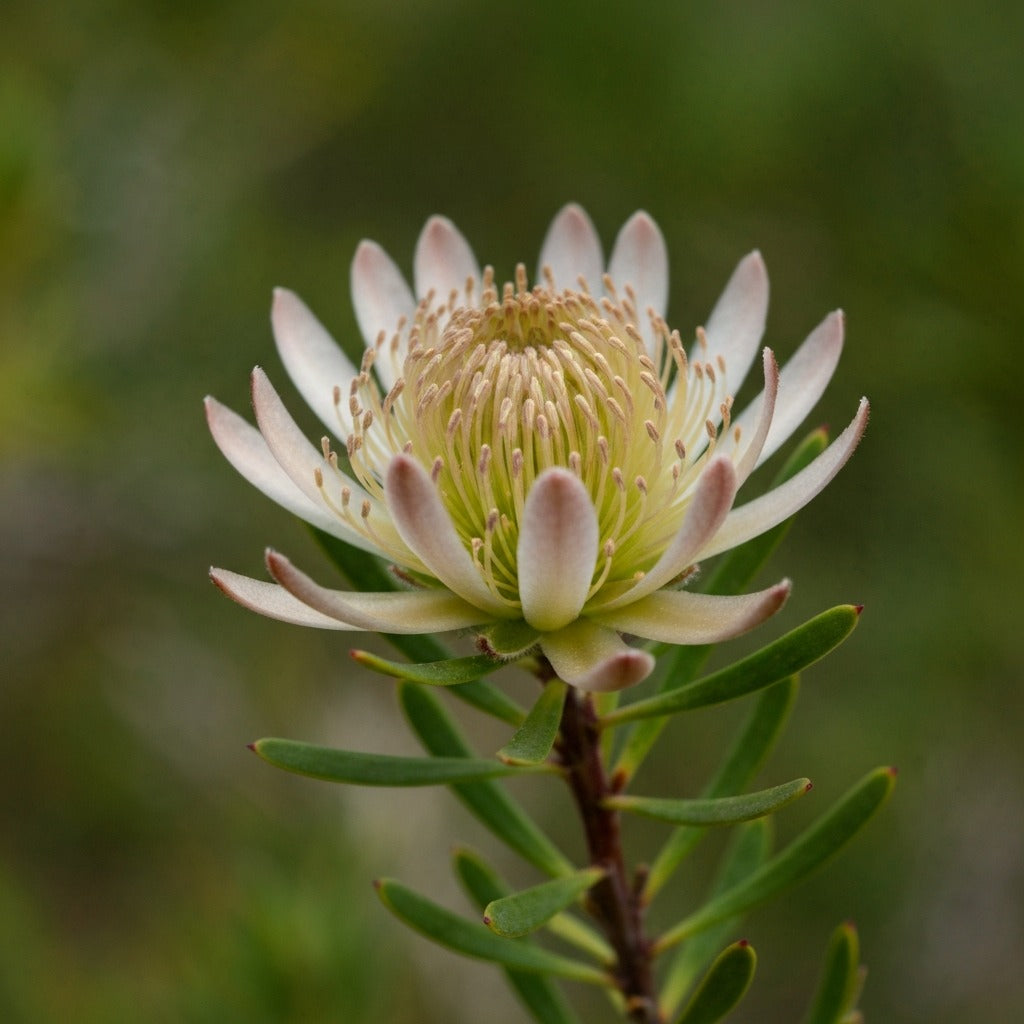
- The common name "pincushion" comes from the distinctive flower head, where dozens of long, protruding styles give the bloom the appearance of a cushion stuck full of pins
- Leucospermum belongs to the ancient Proteaceae family, one of the oldest flowering plant families on Earth [Common botanical/general knowledge]
- The genus currently contains 48 known species, the majority with very limited ecological ranges — many are rare or endangered [Wikipedia]
- Seeds are dispersed by ants in a strategy called myrmecochory: ants carry the seeds underground to feed on their nutrient-rich coating, inadvertently protecting the seeds from fire and enabling germination after wildfires [Wikipedia]
- Some species survive fire by regenerating from a deep underground rootstock; others depend entirely on their buried seed bank for post-fire recovery [Wikipedia]
- The straight stems, large and long-lasting flower heads, and evergreen foliage make Leucospermum highly prized as a cut flower and garden ornamental, and it is widely cultivated in the floral trade [Wikipedia]
- Leaves are leathery and often tipped with 3–17 thickened, bony teeth — a structural adaptation characteristic of Proteaceae growing in nutrient-poor soils [Wikipedia]
- Pollen is transferred internally within the bud: before the flower opens, pollen moves from the anthers to a specialised pollen-presenter at the tip of the style, which then elongates dramatically and forces its way through the closed perianth — an unusual mechanism among flowering plants [Wikipedia]
The Story
The wind that comes off the Cape mountains in late winter carries something particular with it — a dry, herbal sharpness cut with the faintest trace of sweetness. Walk the fynbos on a clear morning in July or August, when the sky is that hard southern blue and the scrub is still damp from overnight dew, and you will find them: round, blazing heads of orange and coral and gold, each one bristling with dozens of raised styles like a cushion pricked full of pins. They do not look like flowers so much as small, concentrated fires.
These are the pincushions — Leucospermum — members of the Proteaceae, one of the most ancient flowering plant families on the planet. The Proteaceae evolved when the supercontinent Gondwana was still intact, and their descendants today are scattered across the southern hemisphere as living evidence of that deep geological past. In South Africa, the pincushion genus has diversified into 48 known species, most of them found nowhere else on Earth. Their ranges are often extraordinarily narrow — a single mountain slope, a specific valley, a patch of coastal limestone — which makes many of them rare, and some of them endangered. This is a flower that exists, in many cases, on the edge of the possible.
Survival in the fynbos demands ingenuity, and Leucospermum has evolved more than one answer to the problem of fire. Some species perish when fire sweeps through but leave seeds behind — seeds that have been carried underground by ants, tucked into nest chambers where the heat cannot reach them, ready to germinate once the ash has cooled. This strategy — myrmecochory, seed dispersal by ants — means the plant has, in effect, outsourced its survival to another species entirely. Other Leucospermum species keep their own insurance: a woody rootstock buried deep in the soil, alive beneath the scorched ground, already pushing new shoots upward before the season has turned. Either way, the pincushion returns.
The flower itself is an engineering curiosity as much as a beauty. Before the bloom opens, pollen is transferred internally from the anthers to a specialised pollen-presenter at the tip of the style. That style then elongates rapidly, forcing its way through the closed perianth lobes — a mechanism so precise and purposeful it reads less like botany and more like design. Once open, the flower head holds its form for weeks, which is why pincushions became a cornerstone of the cut flower trade and why they have been bred and hybridised for gardens far beyond South Africa's Cape.
What remains, across all of this, is something worth carrying. A flower that has learned to survive fire, to partner with ants, to bloom at the edge of extinction with absolute conviction — that carries a kind of quiet confidence most things never achieve. It is why Hibiscus chose this story to travel with you: because every time you reach for this bottle, you carry a piece of the fynbos — that ancient, wind-scoured, fire-tested landscape — and the lesson it has spent millions of years perfecting.
What It Stands For
The Leucospermum stands for resilience at the edge — the capacity to survive fire, adapt against the odds, and return, blazing, exactly as before.
The Perfect Gift
For the person in your life who loves the natural world — who has a soft spot for flowers, feels most at home outdoors, or simply appreciates a beautiful thing that means something real.
Give it for a birthday, a milestone, or any day that deserves a gift she'll actually use. Whether it goes on the trail, to the desk, or on the kitchen bench — it'll be reached for every single day. And every time she does, she carries a story from somewhere real, something that has lasted.
Not just a bottle. The whole story. She just gets to drink from it.
Share