Hibiscus Studio
E1B2_Rose Botanical Water Bottle | Bulgaria Native
E1B2_Rose Botanical Water Bottle | Bulgaria Native
Couldn't load pickup availability
Flower Details
- Common name: Rose
- Country of origin: Bulgaria
- Region: Europe
Bottle Specifications
- High-grade stainless steel
- 17 oz (500 ml)
- Dimensions: 10.5″ × 2.85″ (27 × 7 cm)
- Vacuum flask
- Double-wall construction
- Bowling pin shape
- Glossy finish
- Odorless and leak-proof cap
- Keeps liquids hot or cold for 6 hours
- Hand-wash only
About the Rose
Common name: Rose
Scientific name: Rosa spp. (genus of over 300 species, family Rosaceae)
Native region: Most species native to Asia; smaller numbers native to Europe, North America, and Northwest Africa. Bulgaria is the native country for this product.
Plant height: Plants range in size and form, from trailing and erect shrubs to climbers reaching up to 7 metres (23 ft) in height.
Flower colour: Varies widely — white, pinks, reds, oranges, and yellows.
Flowering season: Typically late spring through summer [Common botanical/general knowledge]
What It's Known For:
- There are over 300 wild species and tens of thousands of cultivated varieties of rose, making it among the most extensively hybridised plants in horticultural history.
- Roses have acquired cultural significance across many societies worldwide, appearing in art, literature, religion, and ceremony across centuries.
- The sharp growths on rose stems are technically prickles — outgrowths of the outer tissue layer — not true thorns, which are modified stems.
- Rose hips, particularly from the dog rose (Rosa canina) and rugosa rose (Rosa rugosa), are among the richest plant sources of vitamin C.
- Rose hips are eaten by fruit-eating birds such as thrushes and waxwings, which disperse the seeds through their droppings, supporting the plant's wide distribution.
- Different rose species hybridise easily, a property that has driven the development of the vast range of garden roses cultivated today.
- A few rose species — particularly those from Southeast Asia — are evergreen or nearly so, while most are deciduous.
- Plant geneticist Zachary Lippman of Cold Spring Harbor Laboratory identified that prickle development in roses is controlled by the LOG gene.
- Roses are insect-pollinated in nature, producing a berry-like aggregate fruit called a "hip" after fertilisation.
The Story
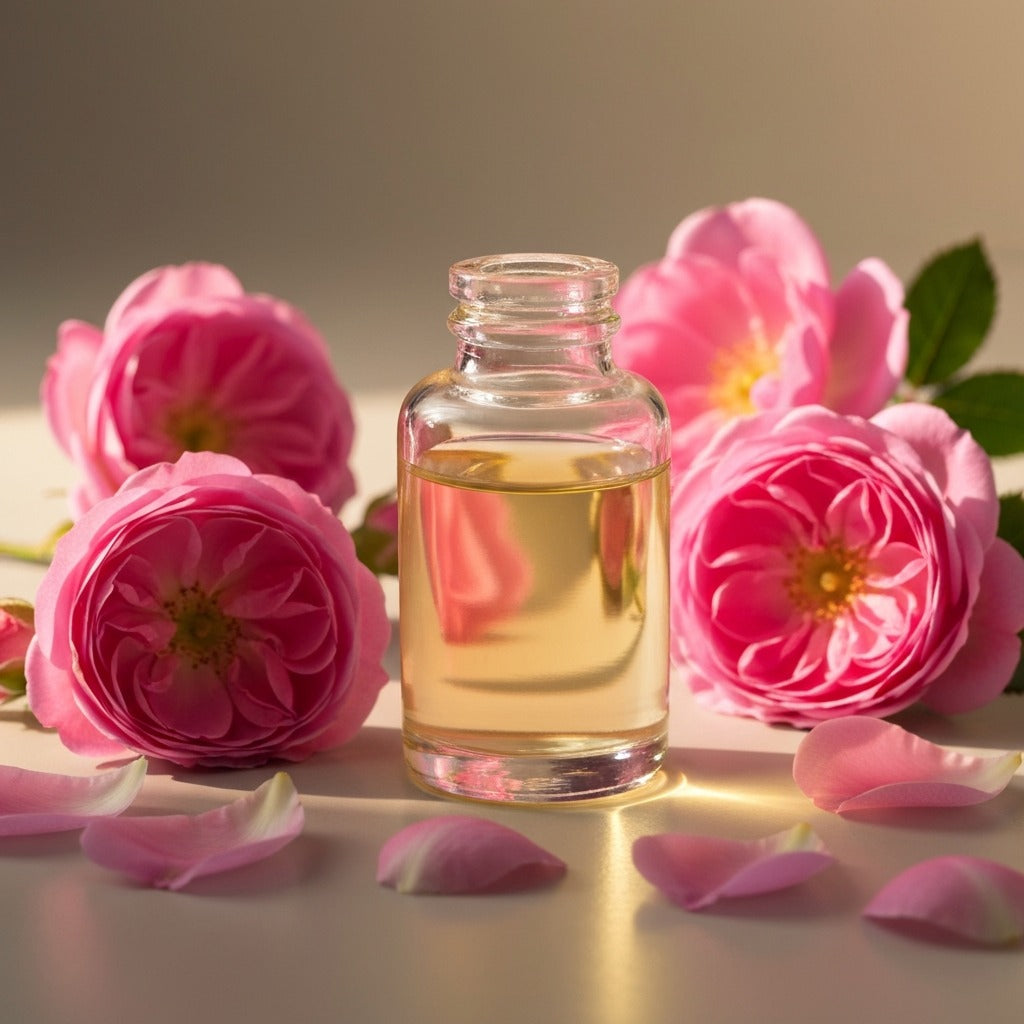
In the valley just south of the Balkan Mountains, before the sun has fully cleared the ridgeline, the air already carries it. Not perfume — something rawer than that. The smell of living petals, dew-wet and warm, rising in the early morning heat of late May. Kilometres of rose bushes stretch in every direction, their pink blooms so dense they seem to bleed colour into the mist. This is the Rose Valley of Bulgaria — the Rozova Dolina — and for a few brief weeks each year, it is unlike anywhere else on earth. [REVIEW: limited documented history — story uses landscape/cultural angle]
The rose has never belonged to just one place or one people. Its name traces a long, winding route through human language: from Old Persian wrd-, through Greek rhódon, into Latin rosa, and eventually into every major European tongue. Across that journey, the flower accumulated meaning — in religious iconography, in the poetry of courts and scholars, in the ceremonies of cultures that had never met. Over 300 wild species spread across Asia, Europe, North America, and Northwest Africa, and wherever they grew, people found ways to honour them. Tens of thousands of cultivated varieties followed, each one a deliberate human act — a choice to preserve a particular colour, a particular scent, a particular shape of petal.
In Bulgaria, the connection runs especially deep. The country's central valley, sheltered by mountain ranges on both sides, creates the precise combination of cool nights, warm days, and high humidity — conditions in which morning dew settles on the petals and the Damask rose produces its oil at its most concentrated. The harvest happens fast and entirely by hand — petals picked at dawn before the volatile compounds begin to dissipate in the heat of the day. The result is rose oil, prized in perfumery for its complexity and depth, with Bulgaria among the most historically significant producers of it in the world. [NEEDS FACT CHECK: specific claim about Bulgaria's global share of rose oil production — not confirmed in verified sources provided]
What the rose also carries, less often remarked on, is a quiet botanical ingenuity. Its prickles — technically not thorns at all, but outgrowths of the outer stem tissue — evolved not as weapons but as anchors, hooking the plant to surrounding vegetation as it climbs. Its hips, the small fruits left behind after flowering, are packed with vitamin C and eaten by thrushes and waxwings, who carry the seeds on through their droppings. The rose does not merely bloom and fade. It persists. It travels. It attaches itself to things and keeps going.
That persistence is exactly what draws people back to it — across languages, across centuries, across the full range of human experience from grief to celebration. A flower that has crossed continents, fed birds, built entire regional economies, and still found its way into a morning garden. Which is why Hibiscus chose this story to travel with you — because some things are worth carrying every day, not just on the days that feel significant.
What It Stands For
The Rose stands for enduring beauty, the depth of human feeling, and the quiet persistence of something that has always found a way to travel further than expected.
The Perfect Gift
For the person in your life who loves the natural world — who has a soft spot for flowers, feels most at home outdoors, or simply appreciates a beautiful thing that means something real.
Give it for a birthday, a milestone, or any day that deserves a gift she'll actually use. Whether it goes on the trail, to the desk, or on the kitchen bench — it'll be reached for every single day. And every time she does, she carries a story from somewhere real, something that has lasted.
Not just a bottle. The whole story. She just gets to drink from it.
Share