Hibiscus Studio
E1F1_Iris Botanical Water Bottle | France Native
E1F1_Iris Botanical Water Bottle | France Native
Couldn't load pickup availability
Flower Details
- Common name: Iris
- Country of origin: France
- Region: Europe
Bottle Specifications
- High-grade stainless steel
- 17 oz (500 ml)
- Dimensions: 10.5″ × 2.85″ (27 × 7 cm)
- Vacuum flask
- Double-wall construction
- Bowling pin shape
- Glossy finish
- Odorless and leak-proof cap
- Keeps liquids hot or cold for 6 hours
- Hand-wash only
About the Iris
Common name: Iris
Scientific name: Iris latifolia (accepted name per POWO/Kew)
Native region: Europe; associated with France as a national and cultural symbol
Plant height: No specific height range is confirmed by either verified source for Iris latifolia — it is a low to medium-growing herbaceous perennial. [Uncertain]
Flower colour: Typically violet-blue to deep purple; cultivated varieties range across white, yellow, and blue tones [Common botanical/general knowledge]
Flowering season: Late spring to early summer [Common botanical/general knowledge]
What It's Known For
- The iris is the national floral emblem of France, deeply associated with the fleur-de-lis symbol woven throughout French royal history and heraldry [Uncertain — see Fact Sources note]
- The genus Iris takes its name from the Greek goddess Iris, the divine messenger and personification of the rainbow [Wikipedia]
- The name reflects the wide range of flower colours found across the genus — matching the colours of the rainbow [Wikipedia, via the goddess connection]
- The iris is one of the most widely depicted flowers in Western art and decorative tradition, appearing in painting, tapestry, and architecture across centuries [Common botanical/general knowledge]
- Vincent Van Gogh's painting Irises is among the most recognised floral artworks in the world [Wikipedia]
- The French sculptor Auguste Rodin created a work titled Iris, Messenger of the Gods [Wikipedia]
- The composer Pietro Mascagni wrote an opera titled Iris [Wikipedia]
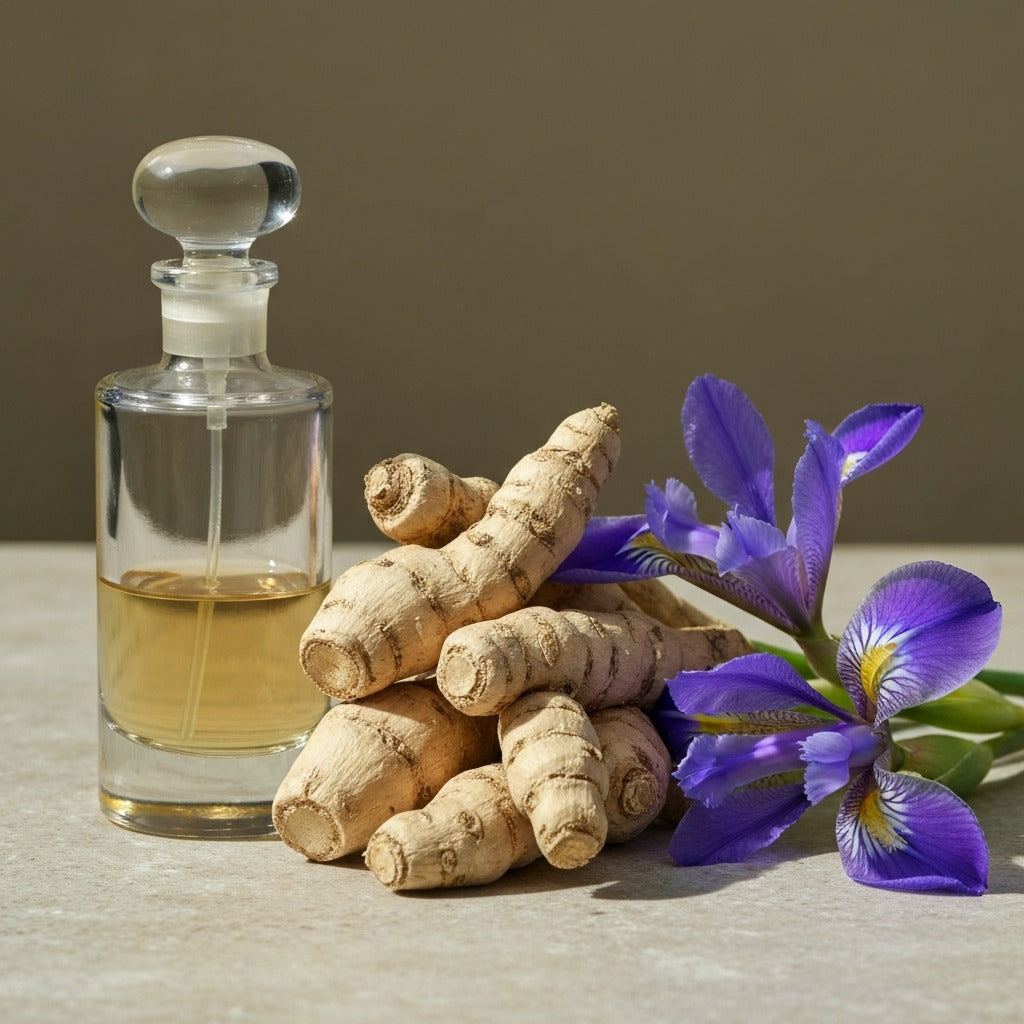
- The iris has been used in perfumery for centuries — orris root (derived from iris rhizomes) is a prized fixative and fragrance ingredient [Common botanical/general knowledge]
- The word "iris" also names the coloured part of the human eye, reflecting the flower's association with light, vision, and the full spectrum of colour [Wikipedia]
The Story
The colour appears before anything else. A wash of violet so saturated it almost reads as blue, trembling at the edge of a late-spring field. The air smells of cut grass and something deeper — earthy, slightly powdery — rising from the soil as the morning warms. This is the moment the iris announces itself: not with a single bloom, but with a whole hillside of them opening at once, as though the landscape has been quietly practising all winter and finally decided to perform.
The flower takes its name from a Greek goddess — Iris, divine messenger, personifier of the rainbow, the thread between heaven and earth. To name a flower after her was not mere poetry. It was an acknowledgement that something in this bloom defies easy categorisation. The petals hold violet, blue, purple, and occasionally white or gold depending on the light and the hour. The ancient Greeks planted irises on the graves of women, believing the goddess would guide them safely along the rainbow to the next world. The name has held ever since — given not only to the flower, but to the coloured ring of the human eye that regulates how much light we allow in.
France claimed the iris long before it had a flag. The fleur-de-lis — the stylised three-petalled emblem that became synonymous with French royalty, heraldry, and identity — is widely believed to represent the iris rather than the lily, though its exact origins remain debated. It appeared on royal standards, cathedral carvings, and the armour of French knights for centuries. Vincent Van Gogh, working in the south of France in 1889, painted Irises in the garden of the Saint-Paul-de-Mausole asylum near Saint-Rémy-de-Provence, during one of the most turbulent periods of his life. The painting, now held in the Getty Museum in Los Angeles, is a document of attention — the act of looking carefully at something alive, and finding steadiness in it. Auguste Rodin, too, chose the flower's name for one of his sculptures: Iris, Messenger of the Gods — the goddess rendered in bronze, still carrying the message forward.
The iris has carried meaning across centuries in other ways too. Orris root — the dried and aged rhizome of certain iris species — has been used in European perfumery for hundreds of years, prized as a fixative that softens other scents and extends their life on the skin. It is quietly present in many of the world's most enduring perfumes, doing invisible work. The iris, in this way, has always been more than its appearance: a bridge between what you see and what you sense, between the visible and the carried.
To hold something that has been this long in the world — that has named a goddess, inspired a painter at his most searching, shaped a nation's identity, and quietly underpinned the perfumes of generations — is to hold a particular kind of depth. It does not announce itself loudly. It simply endures, and rewards the person who pays attention. That is why Hibiscus chose this story to travel with you.
What It Stands For
The iris stands for vision, transformation, and the enduring power of what is beautiful and precise — a messenger between worlds that never stopped carrying its meaning forward.
The Perfect Gift
For the person in your life who loves the natural world — who has a soft spot for flowers, feels most at home outdoors, or simply appreciates a beautiful thing that means something real.
Give it for a birthday, a milestone, or any day that deserves a gift she'll actually use. Whether it goes on the trail, to the desk, or on the kitchen bench — it'll be reached for every single day. And every time she does, she carries a story from somewhere real, something that has lasted.
Not just a bottle. The whole story. She just gets to drink from it.
Share