Hibiscus Studio
E1G2_Olive Blossom Botanical Water Bottle | Greece Native
E1G2_Olive Blossom Botanical Water Bottle | Greece Native
Couldn't load pickup availability
Flower Details
- Common name: Olive Blossom
- Country of origin: Greece
- Region: Europe
Bottle Specifications
- High-grade stainless steel
- 17 oz (500 ml)
- Dimensions: 10.5″ × 2.85″ (27 × 7 cm)
- Vacuum flask
- Double-wall construction
- Bowling pin shape
- Glossy finish
- Odorless and leak-proof cap
- Keeps liquids hot or cold for 6 hours
- Hand-wash only
About the Olive Blossom
- Common name: Olive Blossom
- Scientific name: Olea europaea (the blossom of the cultivated olive tree)
- Native country/region: Native to the Mediterranean Basin; Greece is among the countries with the longest continuous cultivation history [Common botanical/general knowledge]
- Plant height: The olive tree is typically a small to medium evergreen tree, often gnarled and slow-growing with age; cultivated trees are generally kept shorter through pruning for harvest [Common botanical/general knowledge]
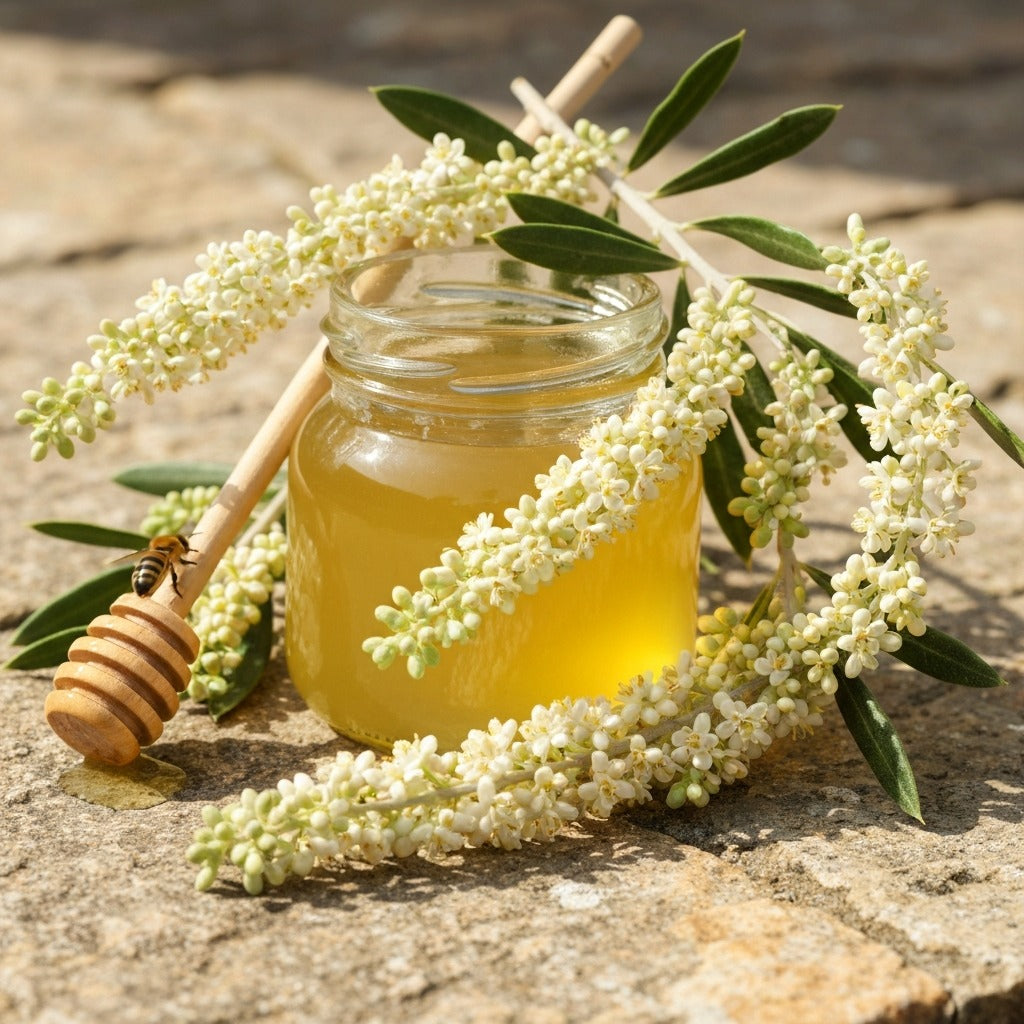
- Flower colour: Creamy white to pale yellow-white, small and four-petalled, borne in loose clusters (panicles) along the branches [Common botanical/general knowledge]
- Flowering season: Late spring to early summer — typically May to June in Greece and across the Mediterranean [Common botanical/general knowledge]
What It's Known For
- The olive tree (Olea europaea) is one of the oldest cultivated trees in human history, with evidence of cultivation in the Mediterranean region dating back thousands of years [Common botanical/general knowledge]
- The blossom is the first stage of olive fruit development; successful pollination of the small white flowers determines the size of the annual olive harvest [Common botanical/general knowledge]
- In ancient Greek mythology, the olive tree was the gift of the goddess Athena to the city of Athens — the tree was considered sacred and its branches a symbol of peace and wisdom [Common botanical/general knowledge]
- Olive branches have been used as symbols of peace across many cultures and civilisations, a tradition that persists in diplomacy and iconography today [Common botanical/general knowledge]
- The olive wreath (kotinos), made from wild olive branches, was the prize awarded to victors at the ancient Olympic Games held at Olympia, Greece [Common botanical/general knowledge]
- Olive trees are exceptionally long-lived; some individual trees in Greece and across the Mediterranean are believed to be over a thousand years old and continue to bear fruit [Common botanical/general knowledge]
- The flower's scent is subtle and honey-like, attractive to bees, making the olive an important early-summer nectar source across the Mediterranean [Common botanical/general knowledge]
- Greece is among the largest producers of olive oil in the world, and the olive harvest remains a central part of rural Greek life and culture to this day [Common botanical/general knowledge]
- Deeply woven into Greek cultural identity since antiquity, the olive branch has appeared on ancient Greek coins — including the celebrated Athenian tetradrachm — its enduring significance inseparable from the goddess Athena and everything she represented [Common botanical/general knowledge]
The Story
The hillsides of the Peloponnese in late May smell like something between rain and honey. The air is warm but not yet heavy, and if you walk between the rows of old trees — their trunks silver-grey and twisted into shapes no two alike — you will find it: small, creamy-white flowers, barely larger than a grain of rice, opening in clusters so dense the branches look dusted with snow. This is the olive in bloom. Quiet, unhurried, easy to miss if you are not looking. But it is the beginning of everything.
The olive tree has been a companion to Greek civilisation for as long as recorded history reaches. Ancient texts, pottery, and archaeological evidence place its cultivation across the Aegean world thousands of years before the common era. The ancient Greeks did not simply grow olives — they built a cosmology around them. Athena, goddess of wisdom, was said to have struck the Acropolis rock with her spear and conjured the first olive tree as her gift to Athens; the city took her name in gratitude. That single story, told and retold across millennia, tells you something about what the tree meant: not just food or oil, but civilisation itself. The ability to settle, to tend, to wait years for a harvest, to plan beyond a single season. So thoroughly did the olive branch become Athena's emblem that it found its way onto ancient Athenian coins — pressed into silver, carried across the known world in every act of trade.
At the ancient Olympic Games, victors were not given gold or silver. They were crowned with a wreath cut from the wild olive tree at Olympia — the kotinos — a circle of grey-green leaves placed on the head of the fastest, the strongest, the most precise. It was considered honour enough. The olive branch, meanwhile, moved across the ancient world as a universal signal: put down your weapons. We come without harm. That symbolism survived the fall of empires, crossed into the Christian and Islamic traditions, and eventually found its way into the United Nations emblem, where olive branches still frame the world map today.
To walk through a Greek village in October during the harvest is to understand that this tree is not history — it is still the rhythm of the year. Nets spread across the ground, hands working through branches, the sharp green smell of crushed leaves, and the slow press of oil that has been part of Greek kitchens and Greek tables for as long as anyone can say. The blossom that opened in May is now the fruit that fills the basket. Every stage of that cycle has its own meaning, its own effort, its own small ceremony.
There is something worth carrying in a flower this unassuming — one that blooms quietly, commits to a slow process, and becomes, in time, something that sustains. It does not announce itself. It simply does what it was always going to do. That patience, that rootedness, that trust in the season — this is why Hibiscus chose this story to travel with you.
What It Stands For
The Olive Blossom stands for peace, endurance, and the quiet wisdom of tending something carefully across a whole lifetime.
The Perfect Gift
For the person in your life who loves the natural world — who has a soft spot for flowers, feels most at home outdoors, or simply appreciates a beautiful thing that means something real.
Give it for a birthday, a milestone, or any day that deserves a gift she'll actually use. Whether it goes on the trail, to the desk, or on the kitchen bench — it'll be reached for every single day. And every time she does, she carries a story from somewhere real, something that has lasted.
Not just a bottle. The whole story. She just gets to drink from it.
Share