Hibiscus Studio
E1I3_Daisy Botanical Water Bottle | Italy Native
E1I3_Daisy Botanical Water Bottle | Italy Native
Couldn't load pickup availability
Flower Details
- Common name: Daisy
- Country of origin: Italy
- Region: Europe
Bottle Specifications
- High-grade stainless steel
- 17 oz (500 ml)
- Dimensions: 10.5″ × 2.85″ (27 × 7 cm)
- Vacuum flask
- Double-wall construction
- Bowling pin shape
- Glossy finish
- Odorless and leak-proof cap
- Keeps liquids hot or cold for 6 hours
- Hand-wash only
About the Daisy
- Common name: Daisy (also: lawn daisy, English daisy)
- Scientific name: Bellis perennis
- Native region: Europe; Italy is among its native homelands within its broad European range
- Plant height: A low, compact herb — a small, ground-hugging plant that sits close to the soil [Common botanical/general knowledge; no specific height figure confirmed by POWO or Wikipedia extract]
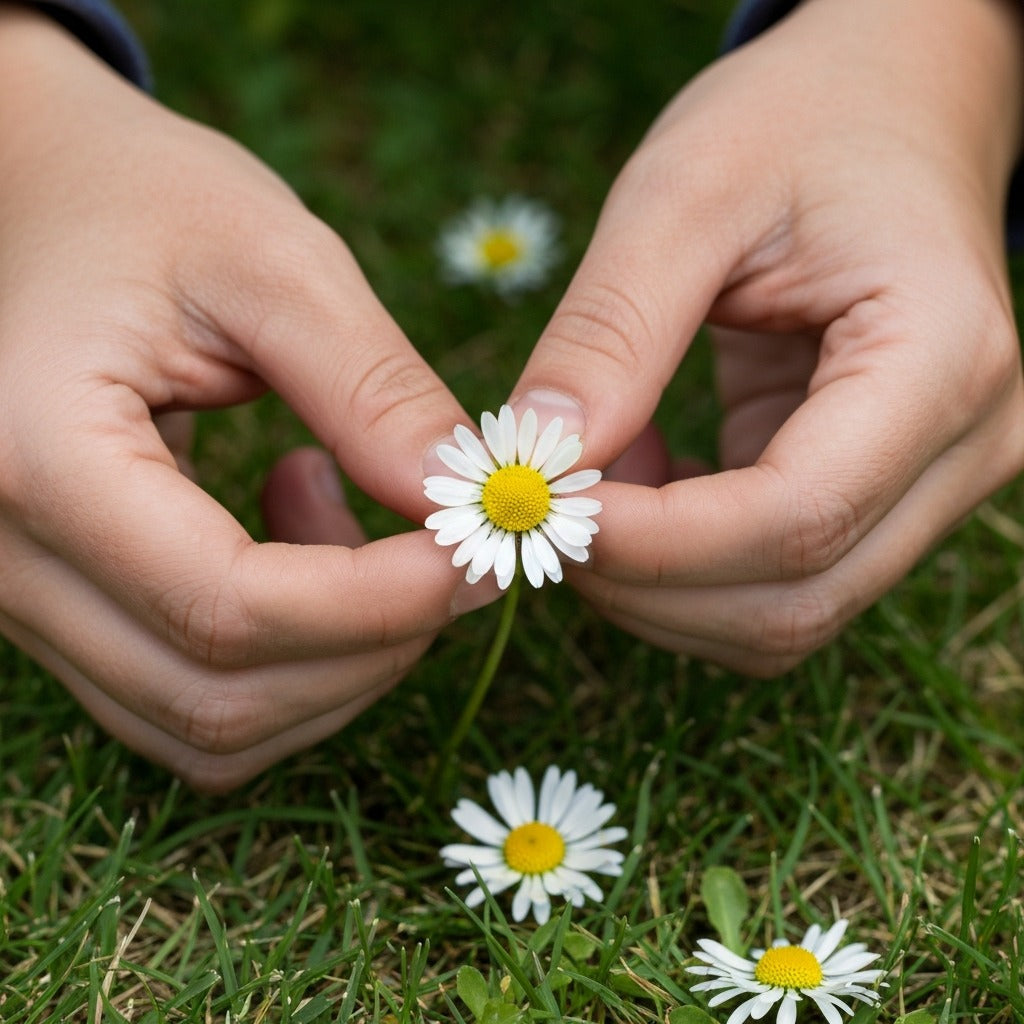
- Flower colour: White ray florets surrounding a bright yellow disc centre [Common botanical/general knowledge]
- Flowering season: Late winter through summer; in mild climates, blooms can appear across much of the year [Common botanical/general knowledge]
What It's Known For
- Bellis perennis is the species most widely recognised under the common name "daisy" in European botanical tradition, native across Europe including Italy [POWO / Wikipedia]
- It belongs to the family Asteraceae — one of the largest flowering plant families — known as the daisy family [Wikipedia]
- The flower has a long association with children's games and folk customs, most notably the practice of making daisy chains [Common botanical/general knowledge]
- The name "Bellis perennis" reflects its perennial nature — "perennis" meaning "everlasting" in Latin, apt for a flower that returns season after season [Common botanical/general knowledge]
- The daisy has been widely used in folk medicine traditions across Europe, historically applied as a remedy for various minor ailments [Common botanical/general knowledge]
- It is among the most recognised wildflowers of European meadows and lawns, prized both as a wildflower and a garden plant [Common botanical/general knowledge]
- The flower's simple two-tone appearance — white petals, golden centre — has made it a recurring symbol in European art, poetry, and decorative craft across centuries [Common botanical/general knowledge]
- The daisy lent its name to the broader daisy family (Asteraceae), which encompasses thousands of species across every continent [Wikipedia]
- The Marc Jacobs fragrance brand "Daisy," launched in the twenty-first century, drew directly on the flower's image and associations for its identity [Wikipedia]
The Story
Lie back in a meadow somewhere in the Italian countryside in late spring — the kind of meadow that exists between a village and a vineyard, unmanaged and unhurried — and you will find them beneath you before you even look. White petals. Yellow centres. Hundreds of them, almost indistinguishable from each other, and yet collectively impossible to ignore. This is where Bellis perennis lives, not commanding attention the way a rose does, not demanding it, but simply there — persistent, familiar, and quietly extraordinary once you stop and really look.
The daisy has been a companion to European life for as long as records stretch. In medieval manuscript illustrations it appears at the feet of the Virgin Mary; in Renaissance paintings it dots the foreground of garden scenes, a quiet detail that grounds the divine in the everyday. Latin gave it a name that told the truth: perennis — everlasting. Not because any single flower lasts forever, but because the plant itself returns, reliably, season after season, from lawn and meadow and roadside verge, unbothered by being mown or walked upon or overlooked. It was this quality — resilience dressed in ordinariness — that made it beloved long before anyone thought to cultivate it deliberately.
In Italy, as across much of Europe, the daisy has lived inside the rituals of childhood with a consistency that few flowers can match. The daisy chain — stems split and threaded into necklaces and crowns — is a gesture so old and so universal that it requires no teaching. Children arrive at it independently, generation after generation, as if the flower itself invites the act. And then there is the petal count: mi ama, non mi ama — he loves me, he loves me not — a small ceremony of hope and chance conducted in meadows and on school lawns from Sicily to the Alps. The daisy held the answer, or at least the permission to believe one.
What makes the daisy remarkable, botanically, is how unremarkable it appears. That yellow disc at its centre is not a single flower but dozens — a composite head, each tiny floret a complete bloom in its own right. The white petals surrounding it are themselves individual ray florets. The daisy is, in this sense, a community pretending to be one thing. Aesthetics concealing architecture. It is one of the reasons the Asteraceae — the daisy family — became one of the largest and most successful plant families on earth, a design so efficient it proliferated into thousands of species across every continent.
There is something worth carrying in that image: a thing that looks simple but is, on closer inspection, made of many. The daisy does not announce itself. It earns its place by returning, by enduring, by being there on the ordinary Tuesday as reliably as on the special occasion. That constancy — quiet, unforced, real — is why Hibiscus chose this story to travel with you, in a bottle you will reach for every day, not just the days that feel like occasions.
What It Stands For
The Daisy stands for quiet resilience — the beauty that doesn't demand to be noticed, but is always, faithfully, there.
The Perfect Gift
For the person in your life who loves the natural world — who has a soft spot for flowers, feels most at home outdoors, or simply appreciates a beautiful thing that means something real.
Give it for a birthday, a milestone, or any day that deserves a gift she'll actually use. Whether it goes on the trail, to the desk, or on the kitchen bench — it'll be reached for every single day. And every time she does, she carries a story from somewhere real, something that has lasted.
Not just a bottle. The whole story. She just gets to drink from it.
Share