Hibiscus Studio
E1N1_Hyacinth Botanical Water Bottle | Netherlands Native
E1N1_Hyacinth Botanical Water Bottle | Netherlands Native
Couldn't load pickup availability
Flower Details
- Common name: Hyacinth
- Country of origin: Netherlands
- Region: Europe
Bottle Specifications
- High-grade stainless steel
- 17 oz (500 ml)
- Dimensions: 10.5″ × 2.85″ (27 × 7 cm)
- Vacuum flask
- Double-wall construction
- Bowling pin shape
- Glossy finish
- Odorless and leak-proof cap
- Keeps liquids hot or cold for 6 hours
- Hand-wash only
About the Hyacinth
- Common name: Hyacinth
- Scientific name: Hyacinthus orientalis (Dutch or common hyacinth)
- Native region: Eastern Mediterranean — southern Turkey, Lebanon, Syria, Iraq, and Iran; widely naturalised across Europe, with the Netherlands becoming its principal commercial centre
- Plant height: 15–20 cm (6–8 in)
- Flower colour: Red, blue, white, orange, pink, violet, or yellow
- Flowering season: Spring
What It's Known For
- Grows from a bulb, producing 4–6 narrow leaves and a single dense spike of intensely fragrant flowers
- Native to the Eastern Mediterranean from southern Turkey through to the Palestine region, Iraq, and Iran, and naturalised widely across Europe and beyond
- The name derives from Greek mythology: Hyacinth was a youth killed by Zephyrus, the god of the west wind, out of jealousy over his love for Apollo; the flowers were said to have sprung from his blood
- The genus name Hyacinthus was formally attributed to Joseph Pitton de Tournefort and used by Carl Linnaeus in 1753
- So popular in 18th-century Netherlands that over 2,000 cultivars were grown there, making the Netherlands its chief historical commercial producer
- Closely associated with spring and rebirth across many cultures
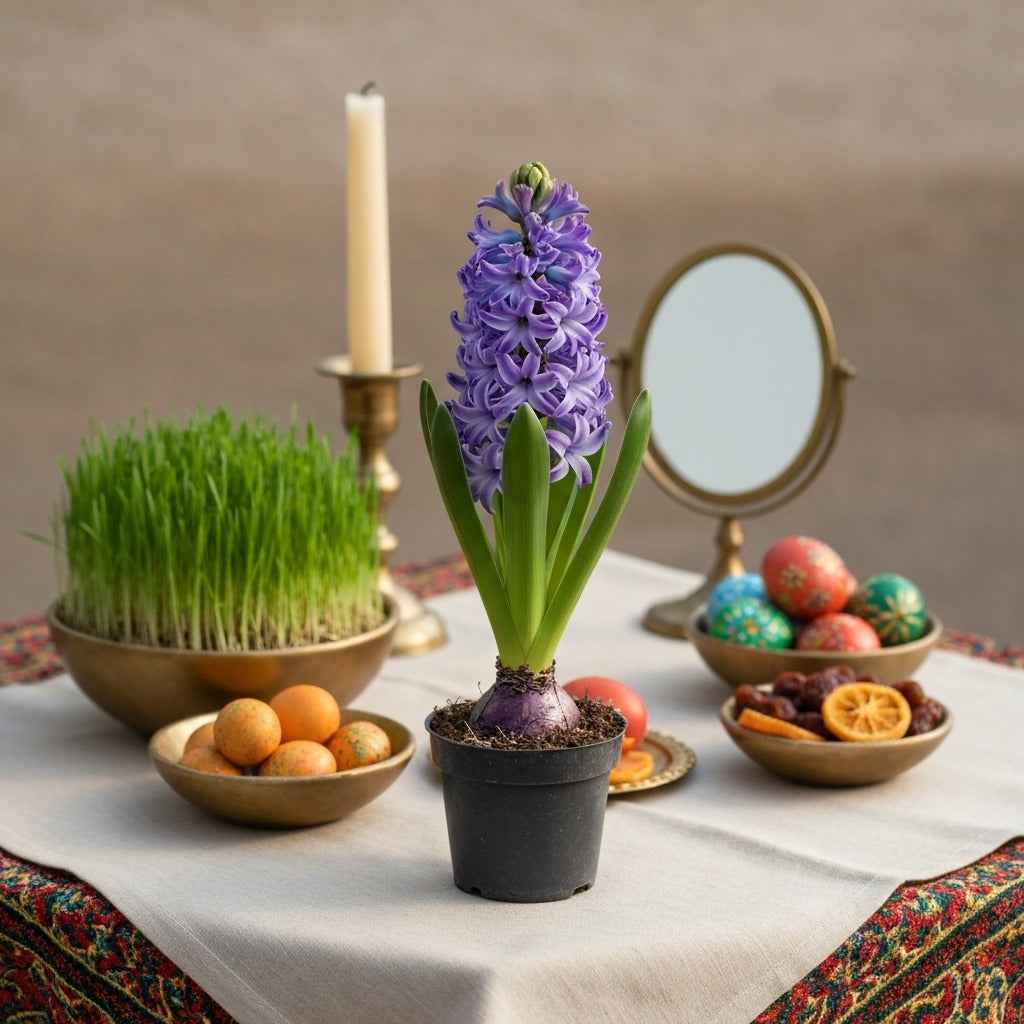
- Used in the Haft-Seen table setting for Nowruz, the Persian New Year celebration held at the spring equinox — one of the most recognisable spring rituals in the world
- The bulbs contain oxalic acid and can cause mild skin irritation, making them inedible and requiring care when handled
- Three species are recognised within the genus: H. orientalis, H. litwinovii, and H. transcaspicus
The Story
Imagine a canal town in early spring — the air still sharp with the last of winter, but something softer moving through it. The canals reflect a sky that has just started to lighten. And then, along every window box and market stall, a colour that doesn't apologise: deep violet, ice blue, white so clean it almost hums. Before you see them clearly, you smell them. Dense, sweet, impossible to mistake. The hyacinths are out.
The story of the hyacinth begins far from the flat Dutch fields that made it famous. Its roots — literal and mythological — are in the ancient Eastern Mediterranean. The Greeks told of Hyacinthus, a youth of such beauty that both Apollo, god of the sun, and Zephyrus, god of the west wind, loved him. Jealous of Apollo's bond with the boy, Zephyrus blew a discus off course during a game, striking Hyacinthus and killing him. From the drops of his blood, Apollo caused a flower to rise from the earth — a flower that would carry the boy's name forever. It is one of the oldest recorded stories of a flower's origin, written into Homer's Greek before botany had a word for the genus.
The flower arrived in Western Europe through trade routes from the Ottoman Empire, and by the 18th century the Netherlands had claimed it entirely. Dutch growers, already masters of the bulb trade, devoted themselves to the hyacinth with characteristic thoroughness. By the height of that century, over 2,000 cultivars had been developed and catalogued — a staggering figure that speaks to both commercial ambition and genuine horticultural obsession. The hyacinth became a symbol of Dutch mastery over nature, of the ability to take a wild Eastern Mediterranean plant and coax it into hundreds of forms, colours, and sizes, each one named and prized.
But the hyacinth was never only a Dutch flower. Thousands of miles to the east, it was held in a different kind of reverence. In Persian tradition, the hyacinth has long held its place on the Haft-Seen table — the ceremonial spread laid out for Nowruz, the Persian New Year celebrated at the spring equinox. Each item on the table begins with the letter "S" in Persian, and the hyacinth (sonbol) stands among them as a symbol of the season turning, of winter releasing its hold, of something new beginning. Two civilisations, centuries apart, looking at the same flower and seeing the same thing: renewal.
There is something in the hyacinth that resists being merely decorative. It carries too much — a myth, a grief, a market revolution, a new year's table set in hope. It is the flower that asks you to pay attention to beginnings. That is why Hibiscus chose this story to travel with you: because every time you reach for this bottle, you carry a little of that same impulse — the one that says winter is over, and whatever comes next is worth showing up for.
What It Stands For
The Hyacinth stands for renewal, remembered grief, and the stubborn beauty of things that return every spring.
The Perfect Gift
For the person in your life who loves the natural world — who has a soft spot for flowers, feels most at home outdoors, or simply appreciates a beautiful thing that means something real.
Give it for a birthday, a milestone, or any day that deserves a gift she'll actually use. Whether it goes on the trail, to the desk, or on the kitchen bench — it'll be reached for every single day. And every time she does, she carries a story from somewhere real, something that has lasted.
Not just a bottle. The whole story. She just gets to drink from it.
Share