Hibiscus Studio
E1N2_Purple Heather Botanical Water Bottle | Norway Native
E1N2_Purple Heather Botanical Water Bottle | Norway Native
Couldn't load pickup availability
Flower Details
- Common name: Purple Heather
- Country of origin: Norway
- Region: Europe
Bottle Specifications
- High-grade stainless steel
- 17 oz (500 ml)
- Dimensions: 10.5″ × 2.85″ (27 × 7 cm)
- Vacuum flask
- Double-wall construction
- Bowling pin shape
- Glossy finish
- Odorless and leak-proof cap
- Keeps liquids hot or cold for 6 hours
- Hand-wash only
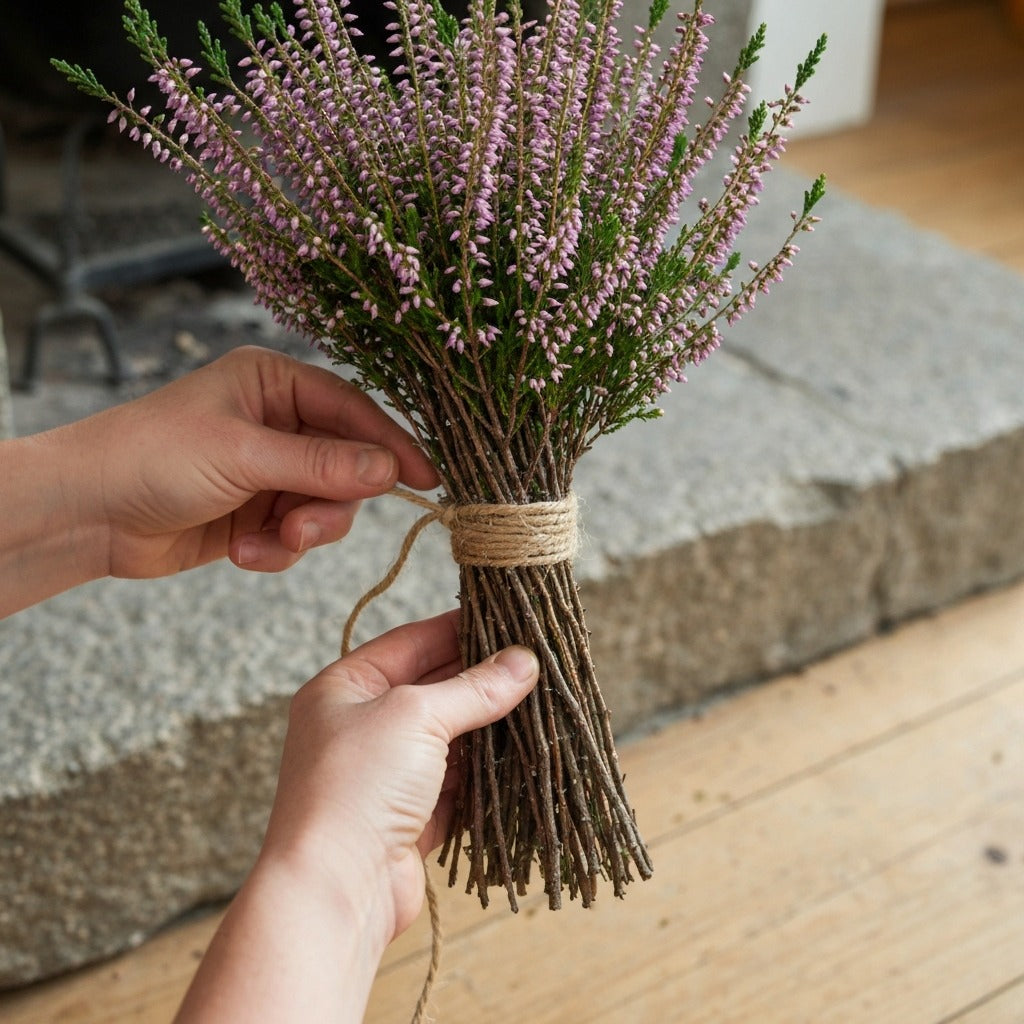
About the Purple Heather
Common name: Purple Heather
Scientific name: Calluna vulgaris
Native region: Europe; native across Norway and widely distributed from the Atlantic coast of Western Europe through Scandinavia and into parts of Asia Minor
Plant size: A low, bushy shrub — typically compact and ground-hugging in exposed upland habitats [Common botanical/general knowledge]
Flower colour: Pale purple to deep lilac-pink, occasionally white
Flowering season: Late summer to early autumn (July–September) [Common botanical/general knowledge]
What It's Known For
- Calluna vulgaris is the dominant ground-cover plant of European moorlands and heathlands, shaping vast sweeps of landscape across Norway, Scotland, Ireland, and northern Europe [Common botanical/general knowledge]
- The name Calluna derives from the Greek kallunein, meaning "to cleanse" or "to sweep" — heather was historically used to make brooms and brushes [Common botanical/general knowledge]
- Purple Heather (Calluna vulgaris) is one of Norway's two widely recognized national flowers, deeply woven into the country's natural identity [Uncertain — national flower status widely cited but not confirmed by either verified source above; flag for review]
- Heather has long been used in folk medicine across Scandinavia and the British Isles — preparations from its flowers and stems were used as mild diuretics and antiseptics [Common botanical/general knowledge]
- The plant provides critical ecological habitat, supporting specialist insects, ground-nesting birds such as red grouse, and pollinators including honeybees [Common botanical/general knowledge]
- Heather honey — produced by bees foraging on Calluna flowers — is prized for its thick, jelly-like consistency and distinctive flavour, and has been harvested across northern Europe for centuries [Common botanical/general knowledge]
- In Celtic tradition, particularly in Scotland, white heather was considered a powerful good-luck charm, associated with the protection of travellers and the blessing of marriages [Uncertain]
- The "Wild Rover" tradition in Norway and Scotland involved gathering heather from high hillsides as a sign of connection to open, untamed land [Uncertain]
- "Wild Mountain Thyme" (also known as "Purple Heather") is a famous folk song associated with the Celtic tradition, with a version written by Francis McPeake [Wikidata]
The Story
The hillside turns colour before autumn has even announced itself. One week the slopes are green and grey; the next, something shifts — and suddenly the whole upland is burning soft purple, stretching from the valley edge to the cloud line, horizon to horizon. No single flower does this. No arrangement, no garden. Only heather, at scale, in the open air, on land that belongs to itself.
Norway has always understood this kind of beauty — unmanicured, vast, earned by wind and cold and the particular patience of a plant that asks very little of its soil. One of Norway's two widely recognized national flowers, Purple Heather (Calluna vulgaris) roots itself into thin, acidic ground where most plants will not go. It blankets the fjordland slopes, the high plateaus, the coastal headlands that face the North Sea. For Norwegians, it is not a decorative thing. It is the landscape itself, visible from the window of every train that climbs north, from every ridge trail that opens above the tree line. You do not visit heather in Norway. You walk into it.
The plant's relationship with human life runs deep and practical. Its Latin name — from the Greek kallunein, meaning "to cleanse" — points to one of its oldest uses: the stiff, branching stems were bundled into brooms and brushes, used to sweep out hearths and homes for generations before purpose-made tools were common. Healers across Scandinavia and the British Isles prepared infusions from its flowers to treat urinary complaints and minor infections. And wherever bees found heather in flower — that brief, concentrated bloom of late summer — they produced a honey unlike any other: thick, almost gel-like, with a flavour that still commands a premium at markets from Bergen to Edinburgh. These were not luxuries. They were the quiet economy of plants that grow where little else will.
The folk tradition around heather is older still. Within Celtic culture — Scottish custom above all — white heather was carried as a good-luck charm by travellers and woven into bridal arrangements as a blessing for new beginnings, a belief so durable it has never quite left the highlands and islands where it took root. And it was from this same cultural ground that one of the most enduring folk songs of the northern Atlantic world emerged: "Wild Mountain Thyme," in a version written by Francis McPeake, weaves purple heather into a landscape of love and longing that has been sung, handed down, and reinterpreted ever since. The flower and the feeling became inseparable.
There is something clarifying about carrying a story rooted in open ground — in a plant that needs no coaxing, no care, only space and sky. Purple Heather is not delicate. It does not wilt at the first cold morning. It covers the hillside and holds its colour long into autumn, long after the season has turned. That kind of quiet persistence — beautiful without effort, strong without display — is why Hibiscus chose this story to travel with you.
What It Stands For
Purple Heather stands for quiet resilience — the beauty that roots itself in hard ground, asks nothing, and colours the whole hillside anyway.
The Perfect Gift
For the person in your life who loves the natural world — who has a soft spot for flowers, feels most at home outdoors, or simply appreciates a beautiful thing that means something real.
Give it for a birthday, a milestone, or any day that deserves a gift she'll actually use. Whether it goes on the trail, to the desk, or on the kitchen bench — it'll be reached for every single day. And every time she does, she carries a story from somewhere real, something that has lasted.
Not just a bottle. The whole story. She just gets to drink from it.
Share