Hibiscus Studio
E1N1_Tulip Botanical Water Bottle | Netherlands Native
E1N1_Tulip Botanical Water Bottle | Netherlands Native
Couldn't load pickup availability
Flower Details
- Common name: Tulip
- Country of origin: Netherlands
- Region: Europe
Bottle Specifications
- High-grade stainless steel
- 17 oz (500 ml)
- Dimensions: 10.5″ × 2.85″ (27 × 7 cm)
- Vacuum flask
- Double-wall construction
- Bowling pin shape
- Glossy finish
- Odorless and leak-proof cap
- Keeps liquids hot or cold for 6 hours
- Hand-wash only
About the Tulip
- Common name: Tulip
- Scientific name: Tulipa spp. (genus; multiple cultivated species and hybrids)
- Native region: Central Asia (likely originating in the Tian Shan and Pamir-Alai mountain ranges); long associated with the Netherlands through centuries of cultivation
- Plant height: A low to compact herbaceous perennial, typically producing a single upright stem; qualitative phrasing used as no POWO height figure was supplied for this entry [Common botanical/general knowledge]
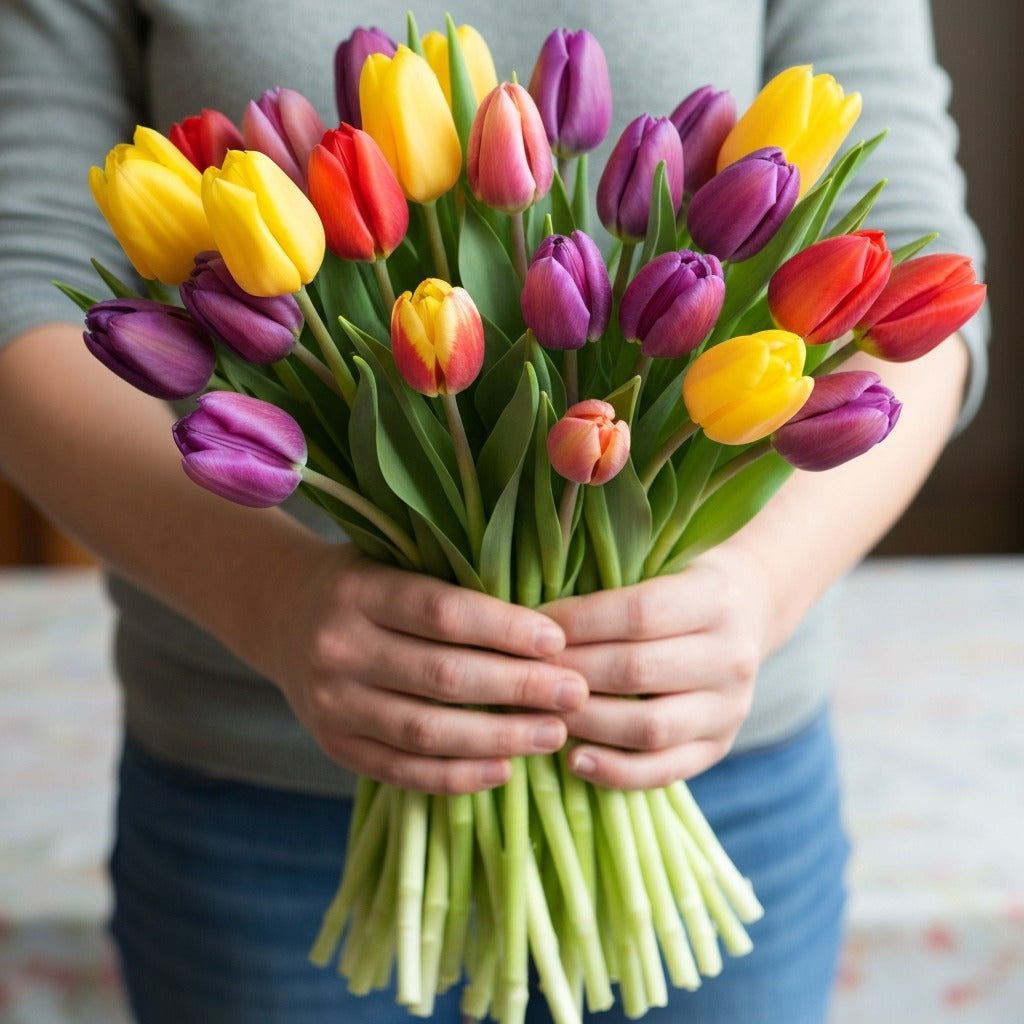
- Flower colour: Extraordinarily variable — red, yellow, orange, pink, purple, white, near-black, and multicoloured striped forms exist across cultivated varieties [Common botanical/general knowledge]
- Flowering season: Spring (typically March–May in the Northern Hemisphere) [Common botanical/general knowledge]
What It's Known For
- Grows from a bulb, dying back completely after flowering and re-emerging the following spring [Common botanical/general knowledge]
- Native wild species originate in Central Asia and the eastern Mediterranean region, not the Netherlands — the Dutch connection is entirely a product of cultivation history [Uncertain — requires verification against a specific historical source]
- The Netherlands became the world's dominant commercial tulip-growing nation; the Dutch bulb industry produces billions of bulbs annually [Uncertain — widely reported but no verified source confirmed in this input]
- "Tulip mania" in the Dutch Golden Age (1630s) is one of the earliest recorded speculative market bubbles, during which single bulb contracts changed hands for extraordinary sums [Uncertain — flag for fact-check before publishing]
- The tulip is closely associated with Ottoman Turkish culture; it was a symbol of paradise and divine perfection in the Ottoman Empire, and the 18th century saw a period known as the "Tulip Era" (Lâle Devri) in Istanbul [Uncertain]
- The word "tulip" is believed to derive from a Turkish or Persian word for turban, referencing the flower's shape [Uncertain]
- The tulip is the national flower of the Netherlands and also holds national flower status in Turkey [Uncertain — widely cited but not confirmed by verified source in this input]
- Tulips are among the most cultivated cut flowers in the global floral trade [Common botanical/general knowledge]
- The Keukenhof gardens in the Netherlands, one of the world's largest flower gardens, is globally associated with annual tulip displays [Uncertain]
The Story
The fields appear almost before you expect them — flat, absolute, stretching to the horizon in bands of red and yellow and violet that seem too deliberate to be natural. The sky above the Dutch polders is enormous. The light falls clean and level across land that was not always land, pulled from the sea over centuries by human will. And there, in that reclaimed earth, in that extraordinary flatness, millions of tulips open their cups to the sky each spring as if they have always belonged here.
They haven't, of course. The tulip's true origins lie far to the east — in the high meadows and mountain passes of Central Asia, where wild species bloom briefly among the rocks before the short growing season closes again. From there the flower traveled, carried by trade and by wonder, into the gardens of the Ottoman Empire, where it became laden with meaning: a symbol of paradise, of divine perfection, of the good life fully lived. For a period in eighteenth-century Istanbul, the cultivation and appreciation of tulips became a cultural obsession — poets wrote about them, festivals were held in their name, and the era itself was named for the flower. [NEEDS FACT CHECK: Specific details of the Ottoman Tulip Era (Lâle Devri) — dates, key figures, and the nature of court tulip festivals — should be verified against a primary historical source before publishing.]
When the tulip reached the Netherlands in the sixteenth century, something remarkable happened. The Dutch — traders, mapmakers, engineers of impossible things — recognised in this flower both beauty and possibility. By the seventeenth century, the bulb trade had grown so fevered that it became one of the earliest documented speculative bubbles in recorded economic history. Rare varieties changed hands for sums that could buy a house on an Amsterdam canal. The bubble burst, as bubbles do. But the tulip stayed. The Dutch soil, the carefully managed water table, the cool maritime spring — it turned out to be perfect. [NEEDS FACT CHECK: Dates and scale of Tulip Mania (commonly cited as 1636–1637) should be confirmed against a verified historical source before publishing.]
What endured was not the speculation but the craft. Generations of Dutch growers learned to coax new colours from the bulb, to extend the season, to fill fields with hues that painters came from across Europe to try to capture. The tulip became inseparable from the Dutch identity — from the wide sky, the low land, the particular quality of April light that has drawn artists for four hundred years. Today the Netherlands remains the centre of global tulip cultivation, sending bulbs to gardens and markets on every continent. [NEEDS FACT CHECK: Current production figures and export dominance claim should be verified.]
There is something quietly powerful about a flower that crosses continents, survives economic madness, and still manages to return faithfully every spring — pushing up through cold soil because that is simply what it does. It asks for nothing extraordinary. It only needs its season. That kind of persistence — unhurried, unshakeable, quietly brilliant — is worth carrying with you, which is why Hibiscus chose this story to travel with you.
What It Stands For
The tulip stands for beauty that endures — rooted in distant mountains, carried across cultures, and faithful enough to return every single spring.
The Perfect Gift
For the person in your life who loves the natural world — who has a soft spot for flowers, feels most at home outdoors, or simply appreciates a beautiful thing that means something real.
Give it for a birthday, a milestone, or any day that deserves a gift she'll actually use. Whether it goes on the trail, to the desk, or on the kitchen bench — it'll be reached for every single day. And every time she does, she carries a story from somewhere real, something that has lasted.
Not just a bottle. The whole story. She just gets to drink from it.
Share