Hibiscus Studio
E1U2_Tudor Rose Botanical Water Bottle | United_Kingdom Native
E1U2_Tudor Rose Botanical Water Bottle | United_Kingdom Native
Couldn't load pickup availability
Flower Details
- Common name: Tudor Rose
- Country of origin: United Kingdom
- Region: Europe
Bottle Specifications
- High-grade stainless steel
- 17 oz (500 ml)
- Dimensions: 10.5″ × 2.85″ (27 × 7 cm)
- Vacuum flask
- Double-wall construction
- Bowling pin shape
- Glossy finish
- Odorless and leak-proof cap
- Keeps liquids hot or cold for 6 hours
- Hand-wash only
About the Tudor Rose
Common name: Tudor Rose (also called the Union Rose)
Scientific name: Rosa
Native country/region: United Kingdom (England); Europe
Height: Not applicable — the Tudor Rose is a symbolic, designed emblem rather than a living plant species, and no botanical height data exists
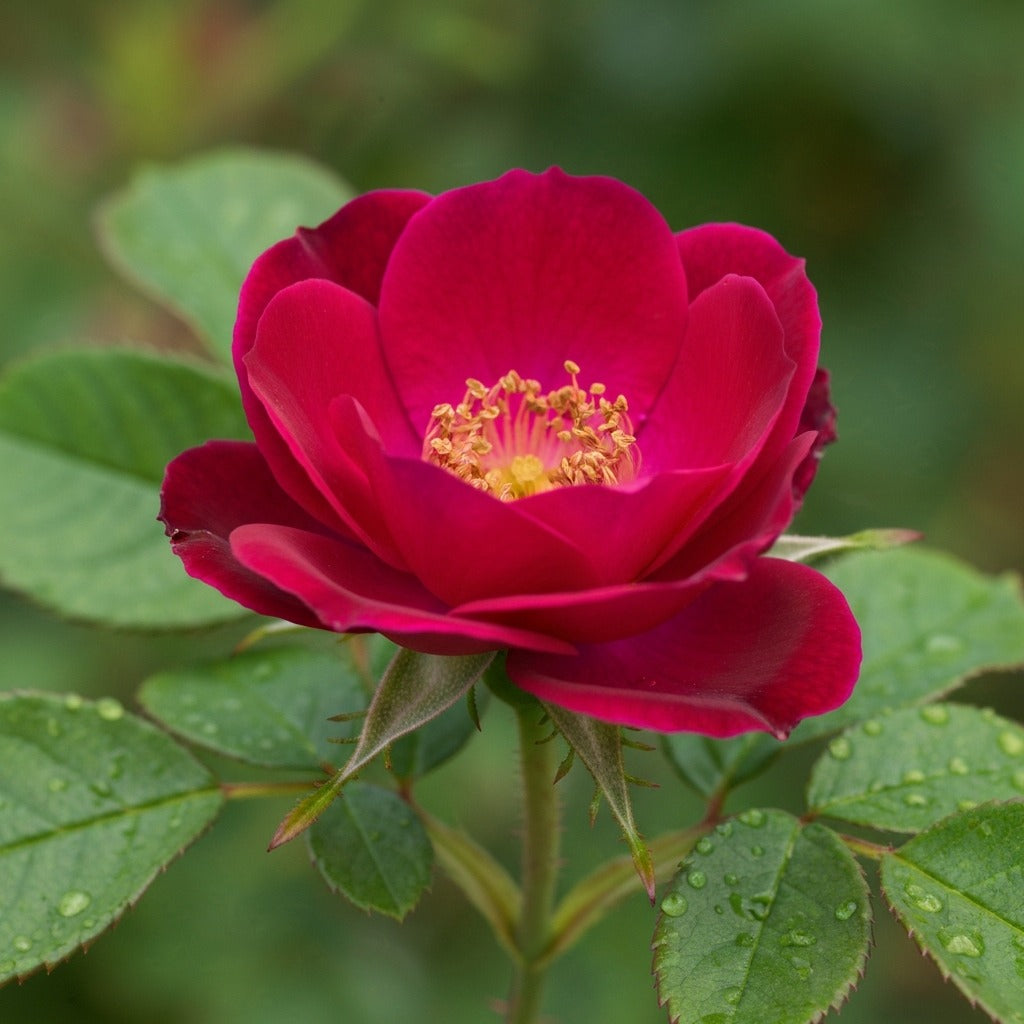
Appearance: A double rose — white inner petals over red outer petals — depicted in heraldry as "proper" (naturally coloured), though this precise combination does not exist in nature
Flowering season: Not applicable
What It's Known For
- The Tudor Rose is the traditional floral heraldic emblem of England, formally representing the nation to this day
- It was created by Henry VII following his victory at the Battle of Bosworth Field in 1485, which ended the civil conflict later known as the Wars of the Roses
- The emblem combines the red rose of the House of Lancaster (Henry VII's line) and the white rose of the House of York, symbolising the unification of the two rival dynasties
- Henry VII married Elizabeth of York in January 1486, and the Tudor Rose badge formally conjoined the two houses' emblems to mark the union
- Historians note that the "Lancastrian" red rose barely existed as a symbol before Henry VII — he largely invented the red-versus-white rose narrative to reinforce his image as a peacemaker king
- Henry VIII had the legendary Round Table at Winchester Castle repainted to include a Tudor Rose at its centre; the Henry VII Chapel at Westminster Abbey was decorated with the Tudor Rose as dynastic propaganda
- The Tudor Rose appears in Nicholas Hilliard's famous "Pelican Portrait" of Elizabeth I, depicted as a slipped and crowned badge (shown with stem, leaves, and a crown)
- Since an Order in Council dated 5 November 1800, the slipped and crowned Tudor Rose has served as the royal floral emblem of England
- The emblem has appeared in compound and dimidiated forms — joined with Catherine of Aragon's Spanish pomegranate badge, and later with the Scottish thistle under James VI of Scotland and I of England
The Story
The year is 1485. A battlefield outside the English market town of Bosworth lies still after one of the most consequential days in English history. The crown has changed hands. A new king — Henry Tudor, of the House of Lancaster — stands where moments before there was chaos, blood, and the end of an age. What comes next is not merely political: it is the careful, deliberate invention of a symbol. And that symbol is a rose.
Henry VII understood, with remarkable clarity, that winning a war and winning a country are two different things. The red rose of Lancaster and the white rose of York had become rallying points for two bitterly opposed dynasties — though in truth, as the historian Thomas Penn records, the red Lancastrian rose "barely existed before Henry VII." Lancastrian kings had used the rose sporadically, and sometimes in gold rather than red. For much of the preceding quarter-century, the only royal rose in England had been the white rose of Edward IV. Henry saw the opportunity to rewrite the visual language of power entirely. In January 1486, he married Elizabeth of York, and the Tudor Rose — red without, white within — was born: a double rose that declared, in a single image, that the war was over and England was one.
The emblem spread deliberately and strategically across the buildings and monuments that shaped English public life. Henry VII decorated the chapel he built at Westminster Abbey — later the site of his own tomb — principally with the Tudor Rose and the Beaufort portcullis, embedding his claim to the throne in stone and colour for all who entered to read. Henry VIII continued the work: at Winchester Castle, he had the Round Table repainted with the Tudor Rose at its heart, pressing even the mythology of Arthur into the service of Tudor legitimacy. When Arthur, Prince of Wales, died in 1502 and was interred at Worcester Cathedral, his tomb bore both roses — asserting his royal descent from Lancaster and York alike, a dynastic argument made in marble. Later, the rose appeared in compound form alongside Catherine of Aragon's Spanish pomegranate and, after the union of England and Scotland, dimidiated with the Scottish thistle under James I.
By the reign of Elizabeth I, the rose had outgrown its origins as political invention and become something deeper — a living emblem of English identity. Nicholas Hilliard captured it in his celebrated "Pelican Portrait" of the queen: a slipped and crowned Tudor Rose, stem and leaves intact, worn as a badge of state. In 1800, an Order in Council formally confirmed what centuries of use had already established: the Tudor Rose is the royal floral emblem of England, and has remained so ever since.
To carry a rose that was designed, not grown — chosen to end a war, to stitch a country back together, and to travel the centuries intact — is to carry one of history's most quietly powerful ideas: that a symbol, once it means something real, outlasts everything that made it necessary. That is why Hibiscus chose this story to travel with you.
What It Stands For
The Tudor Rose stands for unity forged from conflict — the enduring idea that two opposing forces, brought together with intention, can become something stronger than either was alone.
The Perfect Gift
For the person in your life who loves the natural world — who has a soft spot for flowers, feels most at home outdoors, or simply appreciates a beautiful thing that means something real.
Give it for a birthday, a milestone, or any day that deserves a gift she'll actually use. Whether it goes on the trail, to the desk, or on the kitchen bench — it'll be reached for every single day. And every time she does, she carries a story from somewhere real, something that has lasted.
Not just a bottle. The whole story. She just gets to drink from it.
Share