Hibiscus Studio
Trillium Botanical Water Bottle | Canada Native | N1C1
Trillium Botanical Water Bottle | Canada Native | N1C1
Couldn't load pickup availability
Flower Details
- Common name: Trillium
- Country of origin: Canada
- Region: North America
Bottle Specifications
- High-grade stainless steel
- 17 oz (500 ml)
- Dimensions: 10.5″ × 2.85″ (27 × 7 cm)
- Vacuum flask
- Double-wall construction
- Bowling pin shape
- Glossy finish
- Odorless and leak-proof cap
- Keeps liquids hot or cold for 6 hours
- Hand-wash only
About the Trillium
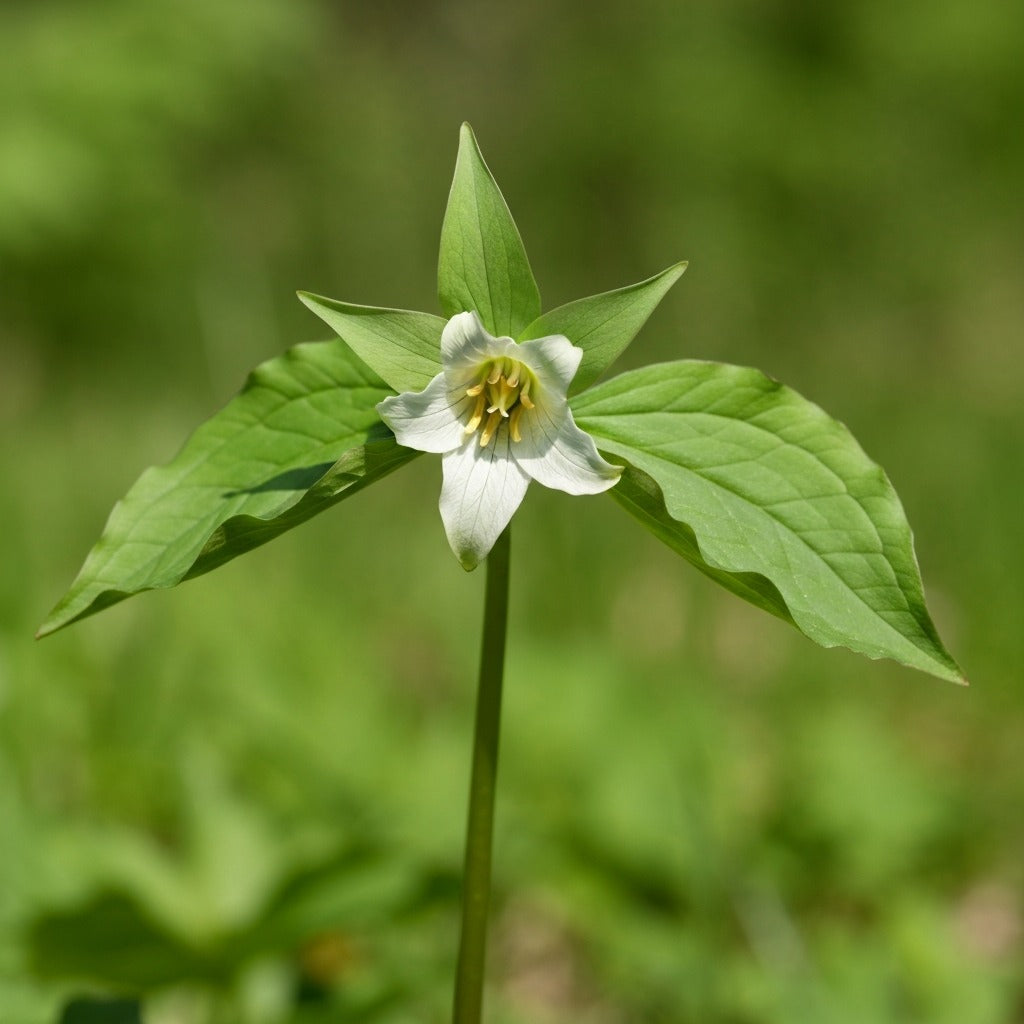
Common name: Trillium (also known as wakerobin, toadshade, tri flower, birthroot, and birthwort)
Native region: Temperate regions of North America and Asia; greatest species diversity in the southern Appalachian Mountains of the southeastern United States; widely recognised as a beloved wildflower of Canada
Plant height: A low perennial herb rising directly from an underground rhizome, typically reaching between approximately 15 cm and 61 cm (about 6–24 inches) depending on species
Flower colour: Petals occur in shades of red, purple, pink, white, yellow, or green, depending on species; sepals are green or reddish
What It's Known For
- Perfect three-fold symmetry — every part of the Trillium flower appears in threes: three leaf-like bracts, three sepals, three petals, six stamens, and three stigmas — a botanical rarity that gives the plant its name
- Formally named by Carl Linnaeus in 1753 — the Swedish botanist established the genus, recognising three original species: Trillium cernuum, Trillium erectum, and Trillium sessile
- Southern Appalachians as a hotspot — the greatest diversity of Trillium species on Earth is concentrated in the southern Appalachian Mountains of the southeastern United States
- Complex taxonomic history — the genus has moved between the families Liliaceae, Trilliaceae, and Melanthiaceae over two centuries of botanical debate; the Angiosperm Phylogeny Group assigned it to Melanthiaceae in 1998
- Occasional four-fold symmetry — rare individuals display tetramerous flowers with four bracts, four sepals, and four petals — a documented anomaly across multiple species including T. grandiflorum and T. erectum
- Cherished wildflower of Canada — the large white trillium (Trillium grandiflorum) is the provincial flower of Ontario, deeply embedded in Canadian natural and cultural identity
The Story
The forest floor is still cold when it happens. The last snow has barely released its grip on the soil, and the hardwood canopy is not yet leafed out — the sky shows through bare branches in pale morning light. Then, low and deliberate among the leaf litter, a flash of white. Three petals, perfectly formed, opening to a woods that has not yet woken up. Spring's first announcement, before the birds have fully returned, before the ferns have uncurled. This is how the Trillium arrives.
The Trillium has been part of the North American woodland story for a very long time. When Swedish botanist Carl Linnaeus formally named the genus in 1753, he recognised three species — Trillium cernuum, Trillium erectum, and Trillium sessile — though even then, the plant had been known and used across the continent long before European taxonomy reached it. Indigenous peoples across North America called it birthroot and birthwort, names that point to practical, life-connected knowledge: the plant's rhizomes were used in traditional medicine associated with childbirth and healing. The common names — wakerobin, toadshade, tri flower — each carry a different relationship between people and this quietly remarkable plant. No single name was ever enough.
In Canada, the Trillium carries particular weight. The large white trillium, Trillium grandiflorum, is the provincial flower of Ontario — a designation that places it among the markers of identity that a place chooses to say something true about itself. Depending on the species, these plants rise anywhere from a few centimetres to roughly sixty, modest in stature and all the more striking for it: white against brown earth, blooming in the maple and beech forests of early spring. For generations the Trillium has marked the turn of the season in the Canadian imagination — not just a flower but a signal that the cold has passed, that the long wait is over, that the woods are opening again.
There is something in the Trillium's timing that stays with people — the way it appears before you expect it, in the gaps of a season not quite finished, patient and precise. A flower rooted in rhizomes that survive the coldest ground. A plant named for the most fundamental act of counting. It belongs to places where you have to look down to find beauty, where the quiet things carry more meaning than the loud ones. That quality — steady, unhurried, worth seeking out — is exactly why Hibiscus chose this story to travel with you.
What It Stands For
The Trillium stands for patience, precision, and the quiet certainty that what has deep roots will always return.
The Perfect Gift
For the person in your life who loves the natural world — who has a soft spot for flowers, feels most at home outdoors, or simply appreciates a beautiful thing that means something real.
Give it for a birthday, a milestone, or any day that deserves a gift she'll actually use. Whether it goes on the trail, to the desk, or on the kitchen bench — it'll be reached for every single day. And every time she does, she carries a story from somewhere real, something that has lasted.
Not just a bottle. The whole story. She just gets to drink from it.
Share