Hibiscus Studio
N1U1_Dogwood Botanical Water Bottle | United_States Native
N1U1_Dogwood Botanical Water Bottle | United_States Native
Couldn't load pickup availability
Flower Details
- Common name: Dogwood
- Country of origin: United States
- Region: North America
Bottle Specifications
- High-grade stainless steel
- 17 oz (500 ml)
- Dimensions: 10.5″ × 2.85″ (27 × 7 cm)
- Vacuum flask
- Double-wall construction
- Bowling pin shape
- Glossy finish
- Odorless and leak-proof cap
- Keeps liquids hot or cold for 6 hours
- Hand-wash only
About the Dogwood
- Common name: Dogwood
- Scientific name: Cornus (genus)
- Native country/region: United States; broadly native across North America
- Plant height: Dogwoods range widely depending on species — from low, spreading shrubs to small ornamental trees. No specific height range is confirmed by POWO or Wikipedia for this product's source material; qualitative phrasing is used here. [Uncertain]
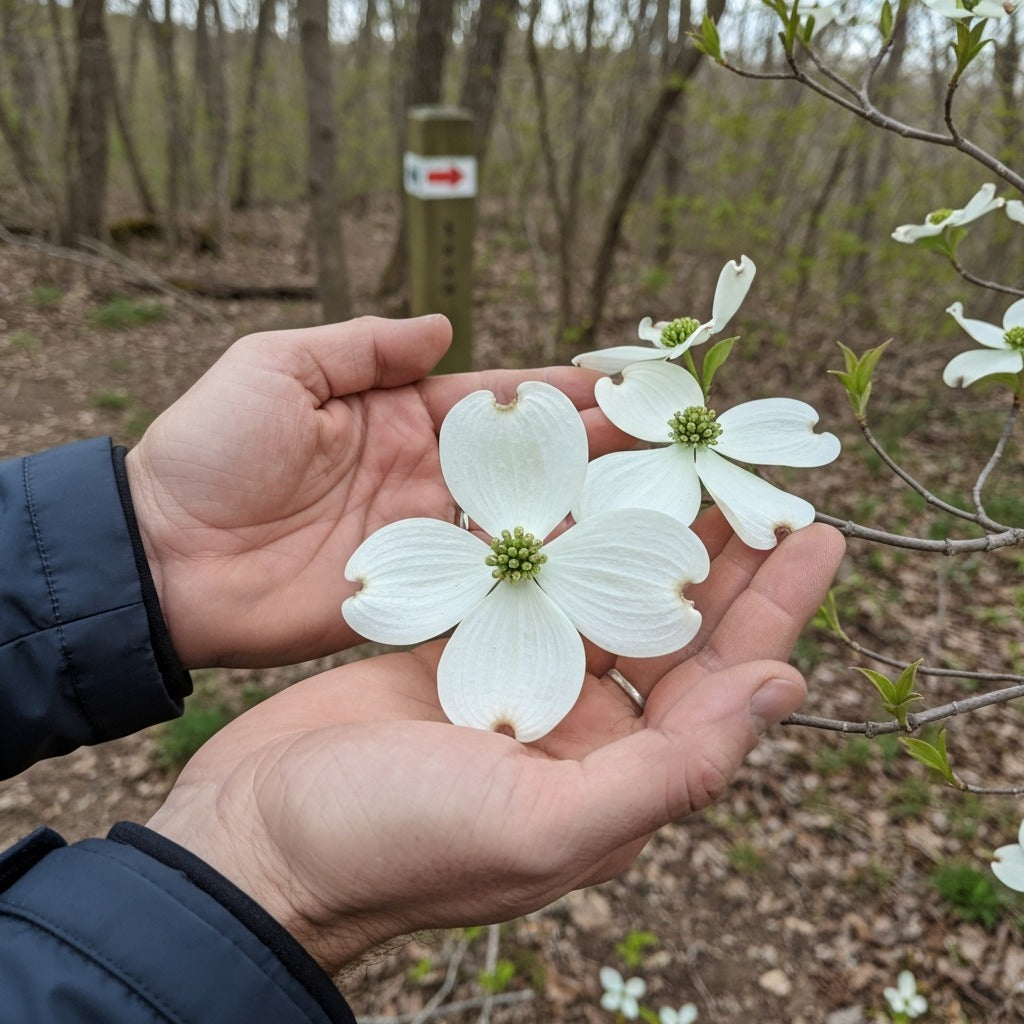
- Flower colour: Typically white or pale pink, with the showy "petals" being modified leaves (bracts) rather than true petals [Common botanical/general knowledge]
- Flowering season: Spring — typically mid-to-late spring in North America [Common botanical/general knowledge]
What It's Known For
- The genus Cornus is widely recognised across North America as a signature spring-flowering tree or shrub [Common botanical/general knowledge]
- The showy white or pink "flowers" of dogwood are technically bracts — modified leaves that surround a cluster of small true flowers [Common botanical/general knowledge]
- Dogwood is the state flower (and state tree) of Virginia, and the state flower of North Carolina [Uncertain — confirm state designations]
- The name "Dogwood" is linked in legend to the wood of the cross — a connection explicitly noted in the band Dogwood's own origin story, where a relative suggested the name "in reference to the legend of the dogwood cross" [Wikipedia]
- Dogwood branches and berries provide critical habitat and food for birds and small mammals across North American woodlands [Common botanical/general knowledge]
- The wood of Cornus species is notably hard and dense, historically used for tool handles, weaving shuttles, and small wooden implements [Common botanical/general knowledge]
- Dogwood blooms are a celebrated marker of spring across the United States, inspiring festivals and cultural traditions in multiple states [Uncertain — confirm specific festivals]
- Several Cornus species have been used in traditional North American herbal practice, with bark preparations documented in folk medicine [Uncertain]
- The genus Cornus is accepted by Plants of the World Online (Kew) as a botanically recognised genus [POWO]
The Story
The first warm days after a long American winter carry a particular kind of suspense. Bare branches hold their silence a little longer than seems fair, and then — almost overnight — the eastern woodlands ignite in white. Not the white of snow, but something warmer: the pale, four-pointed blooms of the dogwood, opening across the understorey like scattered stars, catching light beneath the taller canopy before the oaks and maples have even thought to unfurl.
Dogwood has marked the arrival of spring across North America for as long as people have lived among these trees. For many Indigenous communities of the eastern woodlands, the flowering of Cornus species tracked the seasons as reliably as any calendar — a signal that planting time was near, that the cold had truly broken. European settlers arriving in the seventeenth and eighteenth centuries found the dogwood already deeply woven into the landscape, its hard, dense wood prized for tool handles and small implements that needed to withstand daily punishment. It was useful wood and beautiful wood, which is a rare combination — the kind that earns a tree a long memory.
The tree carries older stories too. In Christian folk tradition, the dogwood became the subject of a legend connecting its four-bracted bloom to the shape of the cross — a story so resonant that it followed the tree across centuries of American religious culture, and gave a punk band from Escondido, California, its name in 1993. When Josh Kemble and his bandmates were looking for something to call themselves, a relative offered "Dogwood" with that legend in mind. It was, in its own way, a good instinct: the name carries weight, and the flower behind it carries more.
Today, the dogwood's bloom remains among the most anticipated events of the American spring. Communities across the country celebrate it, from Appalachian towns to the central states — festivals gathering each year around those few bright weeks of white and pink. In the mountains, the blooms themselves signal the turn of the hiking season, a flush of colour across the understorey that tells you the trails are ready. There is something in the dogwood's flowering that feels disproportionate to its modesty — a small tree, an understorey plant, outshining everything around it for a brief brilliant stretch, then stepping quietly back into the green.
That quality — the willingness to be extraordinary in season and unassuming the rest of the time — is what makes the dogwood worth carrying. It is not a flower that announces itself loudly. It simply appears, on schedule, and takes your breath away. This is why Hibiscus chose this story to travel with you: a reminder that the most lasting things often arrive quietly, in their own time, and are gone before you think to hold onto them.
What It Stands For
The Dogwood stands for quiet resilience — the kind that waits through the cold, arrives at precisely the right moment, and makes the whole world stop to look.
The Perfect Gift
For the person in your life who loves the natural world — who has a soft spot for flowers, feels most at home outdoors, or simply appreciates a beautiful thing that means something real.
Give it for a birthday, a milestone, or any day that deserves a gift she'll actually use. Whether it goes on the trail, to the desk, or on the kitchen bench — it'll be reached for every single day. And every time she does, she carries a story from somewhere real, something that has lasted.
Not just a bottle. The whole story. She just gets to drink from it.
Share