Hibiscus Studio
O1A1_Banksia Botanical Water Bottle | Australia Native
O1A1_Banksia Botanical Water Bottle | Australia Native
Couldn't load pickup availability
Flower Details
- Common name: Banksia
- Country of origin: Australia
- Region: Oceania
Bottle Specifications
- High-grade stainless steel
- 17 oz (500 ml)
- Dimensions: 10.5″ × 2.85″ (27 × 7 cm)
- Vacuum flask
- Double-wall construction
- Bowling pin shape
- Glossy finish
- Odorless and leak-proof cap
- Keeps liquids hot or cold for 6 hours
- Hand-wash only
About the Banksia
Common name: Banksia
Scientific name: Banksia (genus)
Native country/region: Australia (Oceania)
Plant height: Banksias range dramatically in form — from low, prostrate shrubs with branches that grow at or below soil level, to towering trees reaching 30 metres (100 ft) tall. The largest species, B. integrifolia (coast banksia) and B. seminuda (river banksia), frequently exceed 15 metres (49 ft) in height.
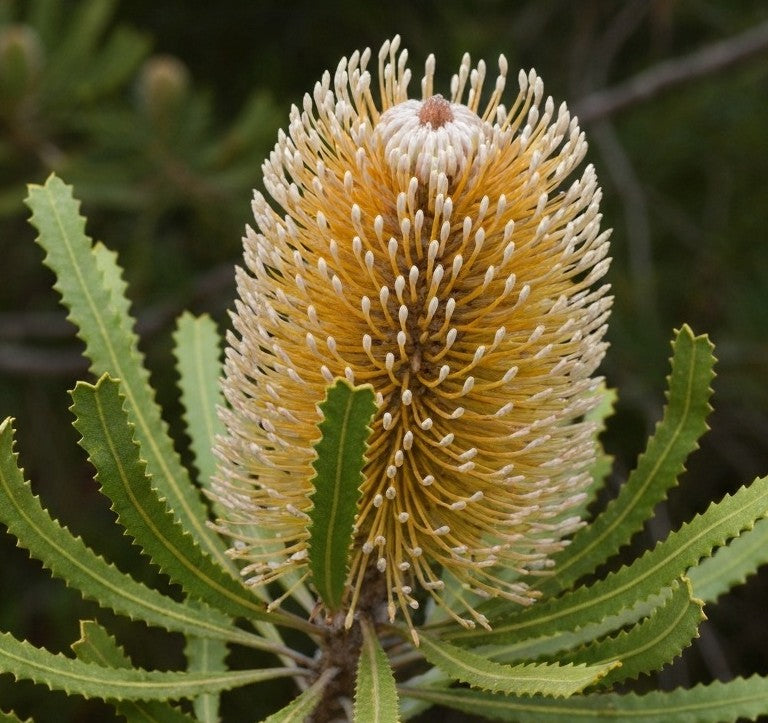
Flower colour: Most commonly shades of yellow; orange, red, pink, and violet also occur across species. Some species produce a spectacular visual colour shift as the flower spike opens — most strikingly in B. prionotes (acorn banksia), where a white bud opens into brilliant orange.
Flowering season: Varies by species across the genus. [Common botanical/general knowledge]
What It's Known For
- A genus of around 170 species, all native to Australia, spanning forests, shrublands, and more arid landscapes — though not the true desert interior.
- Iconic flower spikes — elongated inflorescences packed with hundreds to thousands of individual flowers. A single spike of B. grandis (bull banksia) has been recorded with around 6,000 flowers.
- Vital to Australian wildlife — banksias are heavy nectar producers and a critical food source for birds, bats, possums, rats, stingless bees, and a wide range of invertebrates.
- Extraordinary size range — the genus includes some of the smallest prostrate ground-hugging shrubs in Australian flora alongside trees up to 30 metres (100 ft) tall.
- Distinctive woody "cones" — the fruiting structures are woody and long-lasting, often persisting on the plant for years and giving aged specimens a characteristic rugged texture.
- Colour-changing flower spikes — in several species, the inflorescence visibly shifts colour as flowers open progressively along the spike, creating a living gradient effect.
- Economic significance — banksias are commercially important to Australia's nursery trade and cut flower industry, valued for their striking, long-lasting flower spikes.
- Conservation concern — multiple species are rare or endangered, threatened by land clearing, frequent burning, and disease, making the genus a subject of ongoing conservation effort.
- Highly variable leaf form — leaves across the genus range from needle-like (1–1.5 cm / under an inch) in B. ericifolia to broad and up to 45 cm (18 in) long in B. grandis.
The Story
The Australian bush in late summer holds a particular quality of light — golden, angled, filtering through sclerophyll forest in long shafts that catch the dust and the insects and the fine hairs on the undersides of leaves. Walk into it and you hear the bush before you see it: honeyeaters working fast through the canopy, the dry creak of branches, the occasional loud crack of bark falling from a eucalypt. And rising from the shrub layer, standing sturdy and unhurried, are the flower spikes of the banksia — dense cylinders of colour, each one packed with hundreds of small blooms opening in sequence, a slow procession of gold or orange or deep pink moving up the spike over days.
Banksia is a genus of around 170 species, every one of them native to Australia. They are not a single flower but an entire world — prostrate shrubs that hug the ground in exposed coastal heathland, mid-sized trees spreading through dry sclerophyll forest, and towering species like Banksia integrifolia and Banksia seminuda that reach 15 to 30 metres (49 to 100 ft) in height. The genus was named in honour of Sir Joseph Banks, the English botanist who sailed with James Cook on the Endeavour and collected specimens at Botany Bay in 1770 — one of the earliest systematic botanical encounters between European science and the extraordinary plant life of the Australian continent. Banks returned with thousands of pressed specimens, and the banksia, with its unmistakable architecture, became one of the defining images of that encounter.
What makes the banksia so embedded in the ecology and identity of the Australian bush is not just its appearance but its generosity. These plants are heavy producers of nectar — a reliable, abundant resource in landscapes that are often dry and demanding. Birds, bats, possums, rats, stingless bees, and a host of invertebrates depend on banksias as a food source, woven into food chains that have evolved over millennia. A single flower spike of Banksia grandis can carry around 6,000 individual flowers, each releasing nectar as it opens. In the Australian bush, a banksia in flower is not simply a botanical event — it is a feeding station, a gathering point, a node in a living network. The woody fruiting cones that follow persist for years, holding seeds that in fire-adapted species are released only by heat — life stored, waiting for its moment.
Yet banksias are under pressure. Land clearing, altered fire regimes, and disease have pushed a number of species to the edge. Their survival depends on landscapes being allowed to function — on fire coming at the right intervals, on habitat remaining connected, on the animals that carry pollen continuing to move through the bush. The banksia is not a fragile or delicate flower. It is tough, resinous, built for hard country. But toughness has its limits, and what threatens the banksia is the slow, cumulative weight of a landscape changed faster than evolution can follow.
There is something worth carrying in that: the idea that endurance is not the same as invincibility, that even the most resilient things need the right conditions to keep flowering. The banksia has stood in Australian soil for millions of years, feeding whole ecosystems, blazing orange and gold through the bush light, opening thousands of flowers one by one. It is that patience, that ecological generosity, that particular toughness rooted in place — which is why Hibiscus chose this story to travel with you.
What It Stands For
The Banksia stands for resilience, ecological generosity, and the quiet endurance of a living thing that has outlasted almost everything — and still opens, flower by flower, in its own time.
The Perfect Gift
For the person in your life who loves the natural world — who has a soft spot for flowers, feels most at home outdoors, or simply appreciates a beautiful thing that means something real.
Give it for a birthday, a milestone, or any day that deserves a gift she'll actually use. Whether it goes on the trail, to the desk, or on the kitchen bench — it'll be reached for every single day. And every time she does, she carries a story from somewhere real, something that has lasted.
Not just a bottle. The whole story. She just gets to drink from it.
Share