Hibiscus Studio
O1A1_Everlasting Daisy Botanical Water Bottle | Australia Native
O1A1_Everlasting Daisy Botanical Water Bottle | Australia Native
Couldn't load pickup availability
Flower Details
- Common name: Everlasting Daisy
- Country of origin: Australia
- Region: Oceania
Bottle Specifications
- High-grade stainless steel
- 17 oz (500 ml)
- Dimensions: 10.5″ × 2.85″ (27 × 7 cm)
- Vacuum flask
- Double-wall construction
- Bowling pin shape
- Glossy finish
- Odorless and leak-proof cap
- Keeps liquids hot or cold for 6 hours
- Hand-wash only
About the Everlasting Daisy
- Common name: Everlasting Daisy
- Scientific name: Xerochrysum bracteatum (formerly Helichrysum bracteatum) `[Common botanical/general knowledge]`
- Native country: Australia
- Native region: Widespread across Australia `[Common botanical/general knowledge]`
- Plant height: An erect herb or subshrub, typically reaching anywhere from approximately 30 cm to 1 m depending on species and cultivar `[Common botanical/general knowledge]`
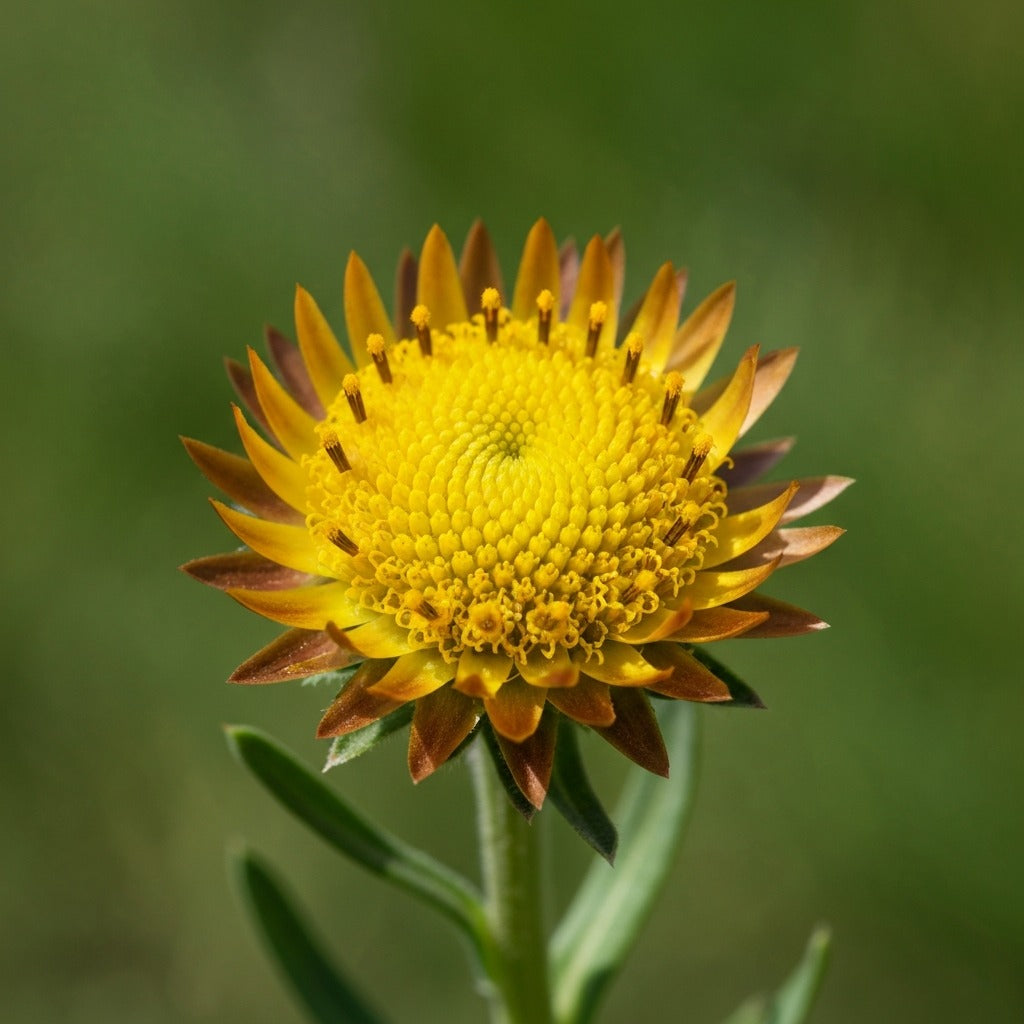
- Flower colour: Yellow, orange, pink, red, white, and cream — with papery, straw-textured bracts that give the bloom its characteristic dry, luminous appearance `[Common botanical/general knowledge]`
- Flowering season: Primarily spring through summer, though flowering can extend across much of the year in warm climates `[Common botanical/general knowledge]`
What It's Known For
- The name "everlasting" refers to the flower's papery bracts, which retain their colour and form long after cutting and drying — an unusually long-lasting quality among wildflowers `[Common botanical/general knowledge]`
- Widely used in dried floral arrangements; the flowers can hold their structure and colour for months or even years when dried `[Common botanical/general knowledge]`
- Native to Australia and found growing in open grasslands, heathlands, and roadsides across the continent `[Common botanical/general knowledge]`
- Among the most widely cultivated Australian native flowers internationally, grown in gardens and for cut-flower trade across warm and temperate regions `[Common botanical/general knowledge]` `[Uncertain — specific cultivation statistics not verified]`
- The genus name Xerochrysum derives from the Greek xeros (dry) and chrysos (gold), a direct reference to the flower's papery, golden appearance `[Common botanical/general knowledge]`
- Cultivated in gardens beyond Australia — including in Europe and North America — though it rarely escapes cultivation in those regions `[Common botanical/general knowledge]`
- Associated in some traditions with remembrance and endurance, owing to its exceptional longevity once cut `[Uncertain]`
- The species is a member of the Asteraceae family — one of the largest flowering plant families on earth — and shares its daisy-like composite flower structure with sunflowers and chamomile `[Common botanical/general knowledge]`
The Story
The Australian summer does not ease you in. It arrives with heat shimmer on dry earth, the creak of eucalyptus in still air, and across the open grasslands — if you know where to look — a low scatter of papery gold that seems to glow even when the sun goes behind cloud. These are not flowers that wilt under the weight of the season. They stand in it. They hold.
The Everlasting Daisy takes its name from the thing that sets it apart from almost every other wildflower: it does not disappear. When other blooms drop their petals and fade back into stem and seed, the Everlasting keeps its shape, its colour, and its quiet presence. The papery bracts — not true petals, but modified leaves that surround the central disc — dry as they grow, locking the flower in a moment that refuses to pass. Cut one in full bloom, hang it, and it may sit on a shelf or in a vase for years, still recognisably itself. In a country that often asks its plants to survive rather than flourish, this is a flower that has found a way to do both at once.
Australia's landscape has always been defined by endurance. Its native flora evolved across some of the world's oldest and most nutrient-poor soils, developing adaptations that prioritise survival over extravagance. The Everlasting Daisy fits this lineage precisely — it is not a showpiece that demands careful tending. It seeds into roadsides, heathlands, and dry open fields with little encouragement, blooming in yellow, orange, deep red, white, and pale cream across a sweep of terrain that stretches from coastal scrub to inland plain. Growing as an erect herb or subshrub — anywhere from knee-height to roughly a metre tall depending on the cultivar — it is modest in stature but outsized in staying power. Gardeners and florists around the world eventually took note, and the species found its way into cottage gardens and dried floral arrangements in Europe and North America, even if it remains largely a cultivated guest in those places rather than a flower that has gone truly wild. `[Uncertain — European cultivation history not verified from a named source]`
What travels with the Everlasting Daisy, wherever it goes, is the particular feeling of something that holds its form under pressure. A freshly cut bloom and a bloom dried six months later look, to a passing eye, much the same. The gold stays gold. The structure stays intact. There is something in that quality — the refusal to collapse, the ability to remain — that has made this flower meaningful to the people who grow it, arrange it, and keep it long after the season that produced it has gone.
That quality of endurance — of carrying something real across distance and time — is what drew Hibiscus to this story. The flower that outlasts the season it was born in, still holding colour and form long after others have gone, belongs on something you reach for every single day.
What It Stands For
The Everlasting Daisy stands for endurance — the quiet kind, the kind that holds its shape and colour long after everything around it has faded.
The Perfect Gift
For the person in your life who loves the natural world — who has a soft spot for flowers, feels most at home outdoors, or simply appreciates a beautiful thing that means something real.
Give it for a birthday, a milestone, or any day that deserves a gift she'll actually use. Whether it goes on the trail, to the desk, or on the kitchen bench — it'll be reached for every single day. And every time she does, she carries a story from somewhere real, something that has lasted.
Not just a bottle. The whole story. She just gets to drink from it.
Share