Hibiscus Studio
Silver Fern Botanical Water Bottle | New Zealand Native | O1NZ
Silver Fern Botanical Water Bottle | New Zealand Native | O1NZ
Couldn't load pickup availability
Flower Details
- Common name: Silver Fern
- Country of origin: New Zealand
- Region: Oceania
Bottle Specifications
- High-grade stainless steel
- 17 oz (500 ml)
- Dimensions: 10.5″ × 2.85″ (27 × 7 cm)
- Vacuum flask
- Double-wall construction
- Bowling pin shape
- Glossy finish
- Odorless and leak-proof cap
- Keeps liquids hot or cold for 6 hours
- Hand-wash only
About the Silver Fern
Common name: Silver Fern (also: silver tree-fern, ponga, punga)
Native country/region: Endemic to New Zealand (Oceania); naturalised in Ireland
Plant height: Grows to 10 metres (33 ft) or more, with a woody trunk reaching up to 12 metres (39 ft) tall and 160–450 mm (6.3–17.7 in) in diameter
Frond size: Mature fronds can reach 3 metres (9.8 ft) long and 1 metre (3.3 ft) wide
Flowering season: Not applicable — the silver fern is a tree fern, reproducing via spores rather than flowers
What It's Known For
- National symbol of New Zealand: The silver fern is among the most recognised symbols associated with New Zealand, used both domestically and internationally to represent the country and its people
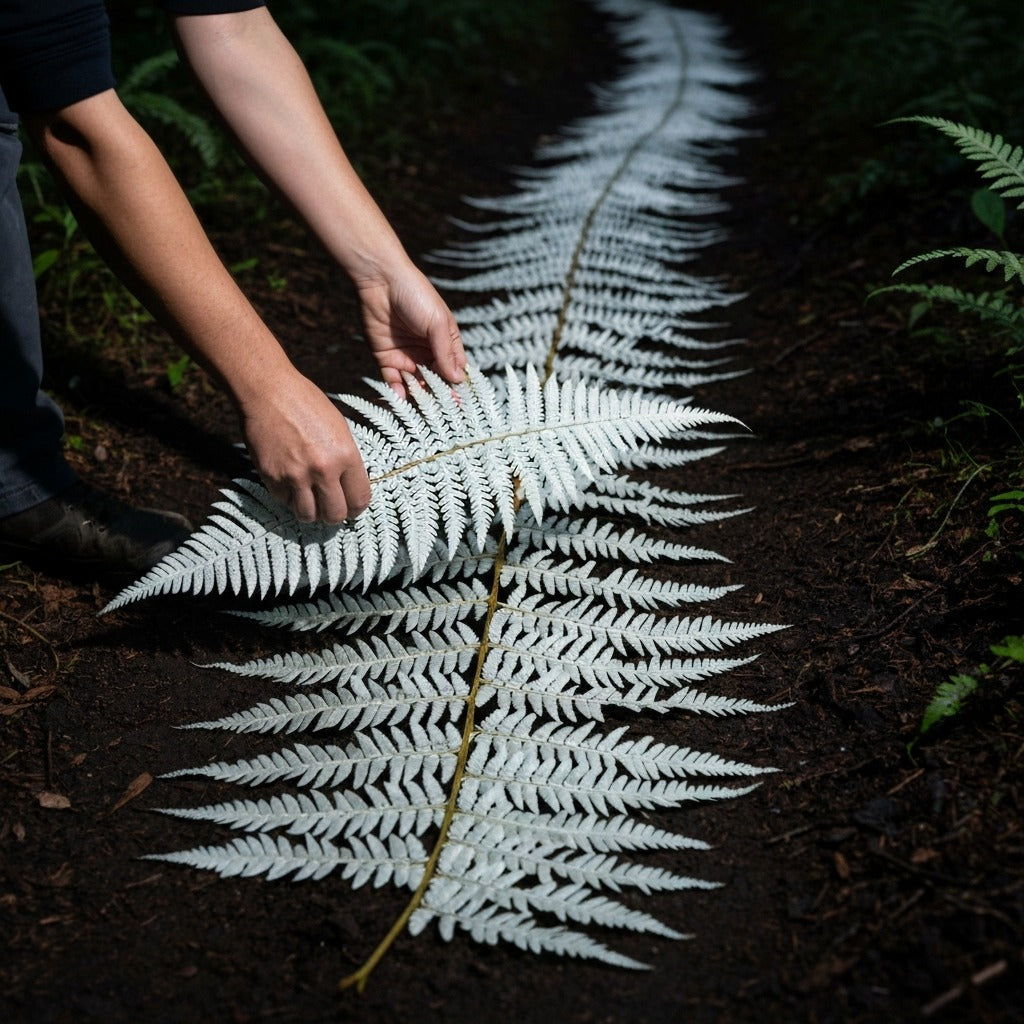
- Distinctive silver underside: The silver-white colouration of the mature frond's underside is unique and immediately identifiable — the species epithet dealbata means "whitened" or "whitish" in Latin, a direct reference to this trait
- Māori cultural name: Known in te reo Māori as ponga or kaponga, the word ponga is shared across Polynesian languages to describe tree ferns and has been adopted into New Zealand English
- Ancient arrival: The silver fern arrived in New Zealand relatively late in geological terms, during the Pliocene epoch, approximately 5.0–1.8 million years ago
- Formally described in 1786: German naturalist Georg Forster first formally described the species in 1786, naming it Polypodium dealbatum in his work Florulae Insularum Australium Prodromus
- Endemic habitat: Found on New Zealand's main islands and the Chatham Islands to the east, with primary habitat in subcanopy areas of drier forests and open scrub — though absent from the west and south of the South Island
- Dense, architectural crown: The crown is notably dense, and the fronds are bipinnately compound or tripinnate — giving mature plants a dramatic, architectural silhouette
The Story
Walk into a New Zealand forest after rain. The canopy drips. The air smells of wet earth and something green and ancient. Look up — and there, arching above you, are fronds the size of small boats, their undersides catching the filtered light and throwing it back as a pale, cool silver. Nothing else in the natural world looks quite like this.
The silver fern — ponga in te reo Māori — has been part of New Zealand's landscape since the Pliocene epoch, arriving on these islands somewhere between 5 and 1.8 million years ago. Long before European contact, Māori navigators and forest travellers had already found a use for that otherworldly shimmer: fronds were laid along tracks through the bush to mark the way for walking at night, the pale undersides glowing faintly in the dark like a trail of scattered moonlight. The word ponga itself travels far — shared across Polynesian languages from Tonga to Samoa, it speaks to a deep, wide relationship between Pacific peoples and tree ferns that long precedes the naming of any single species.
The plant was formally introduced to Western science in 1786, when German naturalist Georg Forster described it in his Florulae Insularum Australium Prodromus, naming it Polypodium dealbatum — the "whitened" polypody, a nod to that silver underside that had already captivated every person who had ever pushed through a New Zealand forest. The species passed through several genera over the following two centuries — reclassified by Olof Swartz in 1801, moved again in 1970 by Rolla M. Tryon Jr. — and even today, its accepted scientific name is contested between major botanical authorities. Kew's Plants of the World Online currently prefers Alsophila dealbata; others still use Cyathea dealbata. For a plant so deeply embedded in a nation's identity, it remains, botanically speaking, beautifully unresolved.
That identity runs deep. The silver fern is among the most recognisable symbols New Zealand has — carried on sports jerseys, worn as a mark of national pride, recognised across the world as a shorthand for the country itself and the people who come from it. It is an emblem earned not through ceremony or decree but through something more durable: the simple, repeated fact of a frond turning silver in the light, generation after generation, in forests that have no equivalent anywhere else on earth.
There is something worth holding onto in that. A symbol that began as a practical guide through darkness — fronds laid on a forest floor to bring someone safely home — and grew into a mark of belonging carried by millions. That is the story this bottle carries, and it is why Hibiscus chose it to travel with you: a piece of New Zealand's living landscape, pressed into something you'll reach for every day.
What It Stands For
The silver fern stands for finding your way — through darkness, through distance, and back to where you belong.
The Perfect Gift
For the person in your life who loves the natural world — who has a soft spot for flowers, feels most at home outdoors, or simply appreciates a beautiful thing that means something real.
Give it for a birthday, a milestone, or any day that deserves a gift she'll actually use. Whether it goes on the trail, to the desk, or on the kitchen bench — it'll be reached for every single day. And every time she does, she carries a story from somewhere real, something that has lasted.
Not just a bottle. The whole story. She just gets to drink from it.
Share