Hibiscus Studio
S1B1_Cattleya Orchid Botanical Water Bottle | Brazil Native
S1B1_Cattleya Orchid Botanical Water Bottle | Brazil Native
Couldn't load pickup availability
Flower Details
- Common name: Cattleya Orchid
- Country of origin: Brazil
- Region: South America
Bottle Specifications
- High-grade stainless steel
- 17 oz (500 ml)
- Dimensions: 10.5″ × 2.85″ (27 × 7 cm)
- Vacuum flask
- Double-wall construction
- Bowling pin shape
- Glossy finish
- Odorless and leak-proof cap
- Keeps liquids hot or cold for 6 hours
- Hand-wash only
About the Cattleya Orchid
Common name: Cattleya Orchid
Scientific name: Cattleya labiata
Native country/region: Brazil, South America
Plant height: A low to mid-sized epiphytic plant — typically growing in compact clumps on tree branches and rocky outcrops rather than from the ground. [Common botanical/general knowledge]
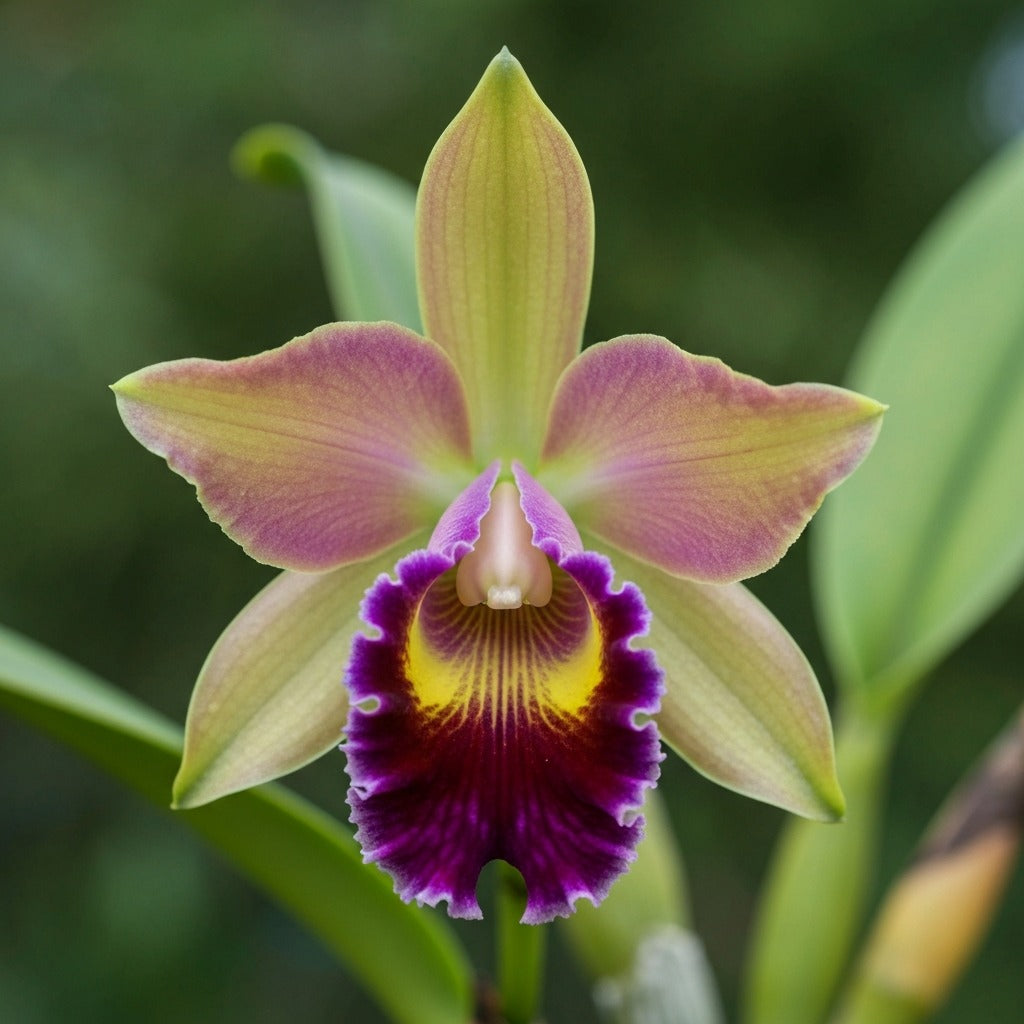
Flower colour: Large, richly pigmented blooms ranging from soft pink and rose to deep magenta, often with a contrasting lip in deeper purple or crimson tones. [Common botanical/general knowledge]
Flowering season: Primarily autumn, though exact timing varies by cultivar and growing conditions. [Common botanical/general knowledge]
What It's Known For
- Cattleya labiata is among the most culturally celebrated orchids in the Americas, long associated with prestige and formal occasions across South America. [Common botanical/general knowledge]
- It is an epiphyte — it grows naturally on the branches and bark of trees and on rocky surfaces, drawing moisture and nutrients from the air and rain rather than soil. [Common botanical/general knowledge]
- The genus Cattleya was named in honour of William Cattley, a British horticulturalist who successfully cultivated the first specimens brought to England in the early nineteenth century. [Common botanical/general knowledge]
- Cattleya orchids became the dominant orchid in Victorian-era corsage culture and were closely associated with formal dress and social ceremony throughout the late 1800s and early 1900s. [Common botanical/general knowledge]
- In Brazil, the orchid holds deep national cultural resonance — Cattleya labiata has been depicted in botanical illustration and fine art, including the celebrated 1871 painting Cattleya Orchid and Three Hummingbirds by American artist Martin Johnson Heade, now held in the National Gallery of Art, Washington D.C. [Wikipedia]
- Heade painted a series of forty small works — titled The Gems of Brazil — depicting Brazilian hummingbirds alongside orchids and tropical jungle settings, a project inspired in part by the work of Charles Darwin and Frederic Edwin Church. [Wikipedia]
- The Cattleya orchid is widely cultivated across tropical and subtropical regions and has given rise to thousands of hybrid cultivars, making it one of the most extensively bred ornamental plants in horticulture. [Common botanical/general knowledge]
- Its large, dramatically formed flowers — described as opulent and richly textured — made it a defining subject of botanical art and natural history illustration from the nineteenth century onward. [Wikipedia / Common botanical/general knowledge]
The Story
Deep in the Atlantic Forest, where the canopy closes over like a green cathedral and mist clings to the branches long after dawn, there is a flower that does not grow in the earth. It clings to the bark of ancient trees, roots bare to the air, drawing life from humidity and light alone. It asks nothing of the soil below. It simply finds a way — blooming in extravagant pink and crimson at the height of the season, suspended between forest floor and sky.
This is Cattleya labiata, Brazil's great orchid. For centuries it grew in relative anonymity in the coastal forests of the country's northeast — present, extraordinary, unremarked upon by the wider world. That changed in 1818, when botanical specimens were shipped to England as packing material around other plants, their purpose purely functional. One of those specimens reached William Cattley, a British horticulturalist who recognised something extraordinary in the strange, fleshy plant tucked among the padding. He cultivated it successfully — and when it flowered, the orchid world was transformed overnight. The genus Cattleya was named in his honour, and what had lived quietly in Brazilian forest light suddenly commanded the attention of collectors, scientists, and artists across Europe and North America.
Among those artists was Martin Johnson Heade, an American painter captivated by the jungles of Brazil. In the 1860s, inspired by Charles Darwin's writings and the sweeping tropical canvases of Frederic Edwin Church, Heade travelled to Brazil with a bold plan: to produce a deluxe illustrated book depicting Brazilian hummingbirds in their natural habitat — a project he called The Gems of Brazil, comprising forty intimate paintings of birds, orchids, and forest. The project was never published. But Heade did not abandon the subject. Through the 1870s he continued painting orchids and hummingbirds together, producing some of the most quietly astonishing works in American art. His 1871 oil Cattleya Orchid and Three Hummingbirds — now held in the National Gallery of Art in Washington, D.C. — captures a pink Cattleya in full bloom against a blue-grey jungle mist, two Brazilian Amethyst hummingbirds hovering at a nest, a Sappho Comet perched nearby. Lichen on dead branches. Moss dripping from trees. The whole living world, held in a panel of mahogany.
It is a painting about attention — about what happens when someone looks closely enough at a wild place and refuses to look away. Heade saw what was there: the orchid not as ornament, but as a living argument for the beauty of the natural world on its own terms.
That quality — the ability to stop a person in their tracks, to insist on being truly seen — has followed the Cattleya orchid across two centuries of art, horticulture, and culture. It is why the flower endures, not just in forests and glasshouses, but in the imagination. It is why Hibiscus chose this story to travel with you: a bloom that asked nothing of the earth it came from, and gave everything regardless.
What It Stands For
The Cattleya Orchid stands for beauty that asks nothing in return — wild, self-sufficient, and impossible to overlook once truly seen.
The Perfect Gift
For the person in your life who loves the natural world — who has a soft spot for flowers, feels most at home outdoors, or simply appreciates a beautiful thing that means something real.
Give it for a birthday, a milestone, or any day that deserves a gift she'll actually use. Whether it goes on the trail, to the desk, or on the kitchen bench — it'll be reached for every single day. And every time she does, she carries a story from somewhere real, something that has lasted.
Not just a bottle. The whole story. She just gets to drink from it.
Share